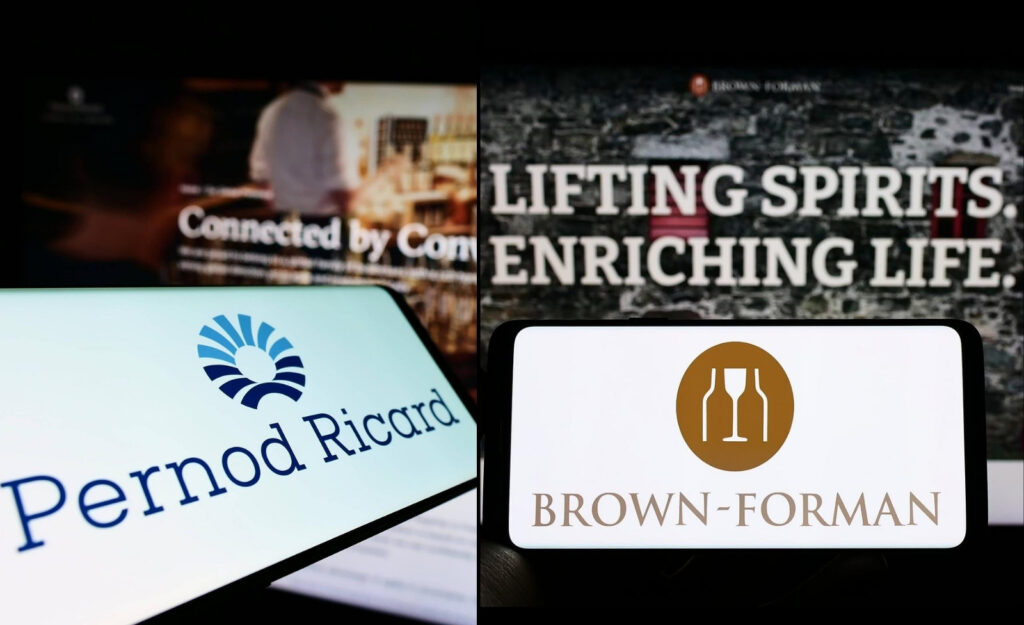
Brown-Forman and Pernod Ricard: Is it Heritage United and Spirits Elevated? And Better For Whom?


For years, a Pernod Ricard/Brown‑Forman merger has been the drinks industry’s favourite bar‑talk fantasy. Now both sides have confirmed they’re in live discussions about what they are positioning as a “merger of equals”, with the usual promises of “significant synergies” and a “balanced geographic footprint” anchored by two iconic families. But if you strip out the corporate choreography, a sharper story emerges: Brown‑Forman stands to bank more upside with less risk, while Pernod Ricard gets the scale it wants – and a long list of headaches it cannot ignore. Read on for TRunblocked.com’s perspective and the likely impact on the travel retail industry.
Brown‑Forman: premium upside, limited downside
Let’s start with the basics. Brown‑Forman has admitted it is “engaged in discussions” with Pernod Ricard, stressing that it regularly evaluates strategic options and that any partnership would create “a global spirits leader with enhanced scale, a powerful brand portfolio, and a balanced geographic footprint”. The language is very carefully chosen – this is not a distressed seller, but a confident brand owner signalling that it will only move for something that fundamentally upgrades its position.
In brand terms, that upgrade is obvious. Brown‑Forman brings Jack Daniel’s, Woodford Reserve and a growing stable of agave and rum brands, but it is still seen as a whiskey‑centric player. Pernod plugs the gaps with Absolut, Beefeater, Jameson, Chivas, Martell and a deep bench of regional gems. Overnight, Brown‑Forman’s route‑to‑market in vodka, gin, Scotch, Irish whiskey and Cognac would go from opportunistic to institutional.
The same logic applies in travel retail. Brown‑Forman has been quietly “doubling down” on the channel over the past two years, reshaping its Global Travel Retail organisation and dialling up its focus on super‑premium launches and channel‑specific storytelling. But it remains a challenger in GTR – strong in American whiskey, less so in other sectors. Plugging into Pernod’s much larger travel retail engine turns GTR from a growth project into a fully wired global stage for its brands.
Financially and politically, the asymmetry is even clearer. Brown‑Forman’s official statement leans heavily on the “merger of equals” line, but the financial market has already interpreted this as a scenario where the French group is effectively the acquirer and Brown‑Forman the prized asset. That means a control premium for Brown‑Forman shareholders, a stock component that gives the Brown family continued influence, and most of the balance‑sheet and integration risk landing on the Pernod side of the table.
Pernod Ricard: scale, story – and strain
Looking at it from Pernod Ricard’s perspective, you can see both the attraction and the strain. By its own account, Pernod’s strategy over the past decade has been about “transform and accelerate” – premiumising its portfolio, deepening in strategic markets, and consolidating its position as the global number two spirits group. Adding Brown‑Forman would lock in that ambition and create a group that can credibly stand shoulder‑to‑shoulder with Diageo in value, reach and category breadth.
In travel retail, the move would supercharge a channel that Pernod already calls its fourth‑largest market and a critical brand‑building platform. The company has just collapsed its three regional travel retail entities into a single global organisation headquartered in London, explicitly to “fully capture the undeniable growth potential” of the channel and to collaborate more effectively with brand companies and key customers. Brown‑Forman’s brands, shopper profiles and innovation cadence slot neatly into that centralised “travel trail” vision.
But scale does not come free. While neither side has disclosed terms, the reality is that any serious business combination involving these two will stretch Pernod’s balance sheet and raise leverage, something equity markets are already nervous about. The public messaging talks up “significant” synergies and shareholder value creation. Yet there is no detail on where those synergies will be found or how quickly they can be delivered. That uncertainty lands squarely on Pernod’s shoulders.
Internally, Pernod also has to manage the friction between a global, metrics‑driven public company and an equally values‑driven, family‑anchored partner. Both groups trade heavily on their heritage and “human” culture. Turning that into a single governance and leadership model without paralysis or politics will be a very long job. In the meantime, every reallocation of brand focus, marketing money or GTR shelf space becomes a potential flashpoint.
The strategic logic: brands, not balance sheets
If you put the capital structure to one side, the brand logic is compelling. Together, Pernod Ricard and Brown‑Forman could credibly claim:
For travel retail specifically, it accelerates existing trends rather than inventing new ones. TRunblocked has already highlighted how brands are doubling down on AI‑assisted segmentation, curated assortments and localisation to drive conversion and distinctiveness in the channel. A Pernod/Brown‑Forman entity could industrialise that: fewer, bigger global platforms, more disciplined SKU counts, and more confident editing of ranges by traveller type, route and price ladder.
That plays straight into the call for “clarity, not clutter” on shelf. In a world where over‑assortment kills conversion, a combined portfolio gives the new group permission to simplify, prioritise and invest behind fewer, stronger anchors in each category. Just think one dominant bourbon or Tennessee whiskey platform instead of three, a single tequila ladder with real depth, a GTR Scotch offer that is curated rather than encyclopaedic.
Where the problems pile up – particularly in GTR
None of this happens in a vacuum. So start with regulators. Any deal that creates a spirits group of this size and breadth will face rigorous scrutiny in the US, Europe and key emerging markets – especially in categories like American whiskey, Scotch and vodka where concentration is already high. Remedies are likely – from regional brand sales to distribution divestments – which could chip away at the very portfolio completeness the deal is supposed to deliver.
Then there is the travel retail eco‑system itself. A channel that already relies on a handful of mega‑suppliers would see one of its most important competitive tensions disappear almost overnight. Pernod today is the aggressive, innovation‑led number two alongside Diageo, whereas Brown‑Forman is a focused, slightly insurgent whiskey specialist. Merge them, and you get a behemoth with enormous leverage over assortment, visibility and investment.
That will spook some stakeholders. TRunblocked has repeatedly pointed out that the industry is already wrestling with the balance between value and experience, and with who really owns the shopper relationship. A super‑sized supplier with even more data, even more control over hero spaces, and even more say in how categories are structured intensifies those debates. It raises uncomfortable questions about whether the channel is designing for “effortless exploration” or simply defaulting to whoever pays the biggest bill.
Operationally, there is a genuine execution risk. Pernod has only just bedded in its global GTR reorganisation. Brown‑Forman is at the mid-journey point on its own travel retail reset, carving out zones and betting on focused super‑premium brand‑building. Asking both organisations to rip up and rewire their structures again in the name of synergy will test both patience and resilience. Talent fatigue is also a real factor, and the risk of losing exactly the kind of agile, challenger‑mindset people travel retail needs is high.
The TRunblocked.com verdict: who really wins?
On both the numbers and the narrative, Brown‑Forman looks like the partner with the greater upside. It gains global, multi‑category scale, a far more powerful travel retail voice and a liquidity event for family shareholders – without being the one expected to carry the heaviest debt or the harshest integration milestones.
In contrast, Pernod Ricard gets something harder to quantify but equally powerful: strategic irreversibility. If it pulls this off, it doesn’t just defend its number‑two slot – it helps define the structure of the global spirits and travel retail landscape for the next decade. But that prize comes with every kind of risk that TRunblocked readers instinctively fear: less diversity of voice on the shelf, more concentrated power, and a huge execution challenge at exactly the moment when the channel needs a much sharper focus, not corporate distraction.
In that sense, “better together” may prove true on brand strategy – especially in travel retail – while still leaving one side of the marriage carrying most of the emotional and financial load. Right now, Brown‑Forman looks like the one walking down the aisle with the better pre‑nup.




To subscribe free, please enter your email address: