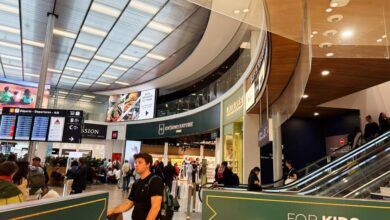



Why Does Travel Retail Keep Meeting Chinese Travellers Too Late?


Well, the headlines you read look reassuring enough: China handled 185 million cross-border movements in Q1 2026, up 13.5% year on year, and SAFE’s January-February data shows travel-related cross-border spend already running at a serious scale.
For an industry hungry for proof that Chinese travel is back, those numbers are more than tempting.
But traffic has a habit of flattering to deceive. Labour Day on May 1st may tell us less about recovery than about whether travel retail still understands when Chinese demand is actually formed. If the traveller is deciding earlier, filtering harder and arriving at the airport with more of the journey already pre-shaped, then visibility at the shelf is no longer enough.
What follows is another excellent and insightful op-ed from Subramania Bhatt, CEO China Trading Desk
Chinese outbound travel does not need another sentimental headline. Labour Day 2026 will produce the optics the industry likes: fuller flights, busier terminals, louder signs of movement and the familiar reassurance of a market back in motion. China’s National Immigration Administration says the country handled approximately 45.8 million outbound trips by mainland residents, up 14.2% Year-on-Year. China’s outbound travel spend reached USD 25 billion in January and USD 19 billion in February, showing Chinese residents were already spending heavily abroad in the first two months of the year.
The traffic is real. The spending is real. That is exactly why travel retail should be worried.
Because the more useful question is no longer whether Chinese travellers are back. It is whether the industry is still arriving too late.
CTD’s Labour Day 2026 outlook already points to a more front-loaded booking cycle around the May 1–5 holiday, with travellers planning earlier, responding more actively to airfare changes and using annual leave to stretch the trip window. The implication is simple: by the time many Chinese travellers reach the airport, more of the decision-making has already happened than the industry still likes to admit.
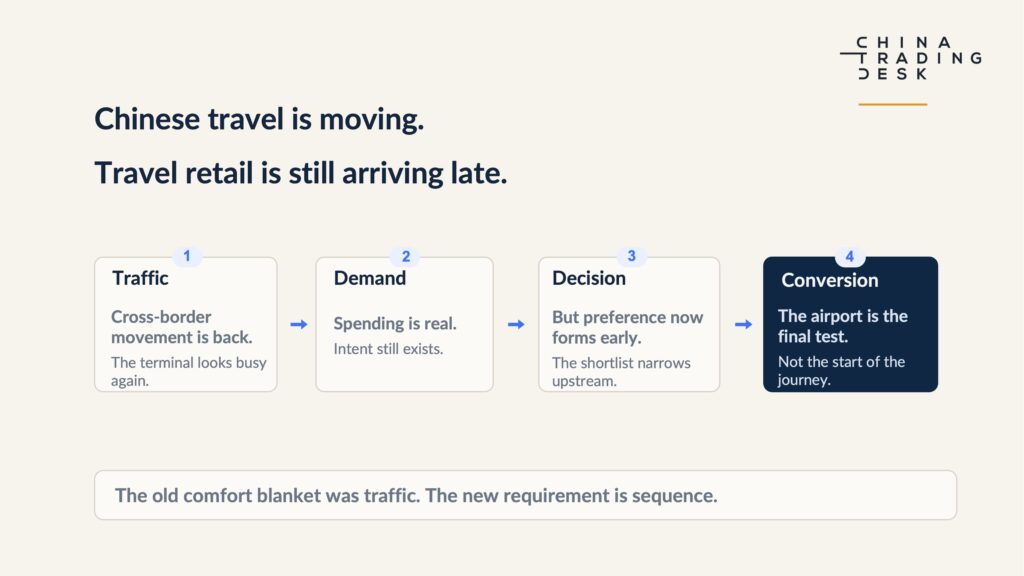
That should matter enormously to travel retail because it changes the role of the airport.The airport is no longer where demand begins. Increasingly, it is where demand either gets fulfilled efficiently or quietly lost.
We see the same pattern in our own market diagnostics. In one recent China Trading Desk (CTD) assessment of a major luxury brand in Seoul, the brand showed strong discovery and desire signals but scored just 21 out of 40 overall because conversion readiness remained structurally weak. In a separate CTD diagnostic of a premium beauty player in Singapore, conversion readiness scored only 4 out of 14. In both cases, the issue was not whether Chinese demand existed. It was whether the path from discovery to store visit, appointment or purchase was clearly owned.
That is the real commercial message inside CTD’s Q1 2026 China Outbound Travel Survey. While near-term travel softened to 21.6%, airport travel-retail propensity held at 64.3%. But the most important detail is where that intent sits. HNWI travellers score 76.0% on airport retail propensity; frequent travellers reach 71.8%. This is not a market offering easy, broad-based conversion. It is a market where the most valuable opportunity is concentrated in narrower, more confident, more conversion-ready audiences.
At the same time, the barriers to purchase are embarrassingly basic. Among travellers who do not buy duty-free, 33% say they cannot find the brands or products they want, 28% say prices are too high, and 21% say there is not enough time. That is not a crisis of desire. It is a crisis of retail fundamentals.
And Labour Day is exactly the kind of holiday that punishes weak fundamentals.
Compressed travel windows do not create dreamy, leisurely shoppers. They create people on a mission. Some are moving with their family. Some are extending the break while protecting a carefully planned budget. Some are premium travellers who already know what they will spend on, and what they will not. All of them are more likely than before to arrive with a shortlist in their heads, whether explicit or not.
This is where travel retail still flatters itself.
For years, the sector benefited from a version of Chinese outbound demand that was easier, louder and more forgiving. That era encouraged some very bad habits: generic localisation, lazy assumptions about price advantage, vague merchandising and the belief that terminal presence was close enough to relevance.
It no longer is enough.
Today’s Chinese traveller is not harder to win because they have become irrationally demanding. They are harder to win because they have become better editors – better at comparing, better at screening out weak value, and better at deciding what is worth stopping for before they even clear security.
The real shift happens before the airport. That is also why China Trading Desk has launched China Marketing AI. In China, the visibility battle is no longer fought at the shelf. It is fought upstream, on the platforms where discovery and preference are formed before the traveller ever reaches the terminal.
That should be unsettling for any operator still obsessed with in-terminal theatre but underinvested in pre-trip relevance. A beautiful store cannot compensate for being absent from the traveller’s decision journey. A Chinese-language sign cannot compensate for weak upstream visibility. A holiday promotion cannot do very much if the traveller has already formed a preference elsewhere and your brand never made the shortlist in the first place.
This is why the Labour Day test is so unforgiving. It reveals whether the industry has understood sequence. Demand is created first. Preference is filtered next. Conversion comes last. Travel retail is still too often treating itself as the opening act when it is really the final scene.
And if it arrives at that final scene without product clarity, pricing credibility, mission fit and some pre-existing mental availability, then it is not being denied a sale by bad luck. It is being denied a sale by timing.
The winners this Labour Day will not simply be those with the best locations or the heaviest footfall. They will be the ones that understand that Chinese shoppers now arrive already influenced elsewhere. They will be the ones that treat airport retail as a downstream conversion point connected to upstream visibility. They will be the ones that understand that a premium traveller does not want more drama, only more confidence. That a time-poor family traveller does not need seduction, only speed. That a selective shopper is not looking for more choice, but for faster proof that this stop is worth the effort.
The old comfort blanket was traffic. The new requirement is sequence.
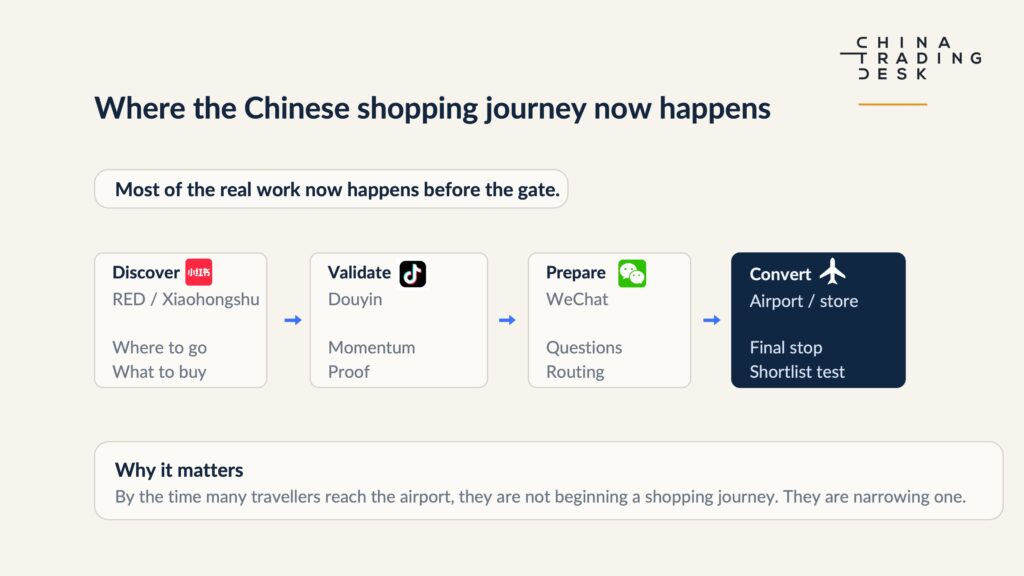
And that is why travel retail’s China problem is no longer simply commercial. It is informational. Too many brands and operators still do not know where demand is being created, reinforced and lost before the airport ever gets a chance to capture it. In China, the visibility battle is now fought upstream, long before the shelf gets its opportunity.
So yes, Chinese travellers will move this Labour Day. The numbers already tell us that. But the more important truth is this: many of them will have moved on long before they reach the gate.
And travel retail still looks far too surprised by that.












To subscribe free, please enter your email address: