

Fraport Bulgaria, With Partners Avolta and Lagardère Travel Retail, Set New Regional Airport Industry Benchmark with Varna and Burgas Airports.


I recently had the opportunity to spend a few days in Bulgaria visiting the reimagined Varna and Burgas Airports. To say that I was impressed would be an understatement. As you will read in this remarkably transparent interview with Fraport Bulgaria’s CEO, Michael Reusch, things have not been easy for Bulgaria – especially given the prevailing geopolitical situation. But the company has stuck with its plans and delivered two quite remarkable regional airports – even though their respective passenger numbers do not exceed 2 million a year each.
Fraport is clearly looking to the future and to increasing traffic to the beautiful Black Sea coast. It will happen and the airports are ready. And there’s more investment to come. Fraport Bulgaria is showing the way how regional airports can be world class and make money!
Peter Marshall (PM): Michael, welcome to TRunblocked.com. Now, you’ve only been here as CEO for Fraport Bulgaria for three months. What are your initial thoughts of the airport market here and the key passenger trends? We know that passenger numbers declined last year and still look relatively soft, although you have recently been gaining some ground. And, of course, we know the reasons why – traffic has been lost because of geopolitical reasons. Passengers from Russia, Belarus and Ukraine, key passenger countries for you, have largely disappeared.
So the question is: what concrete market diversification strategies are you planning to grow your passenger base – regardless of what happens with the outcome with the Russia/Ukraine war?
Michael Reusch (MR): That’s many questions in one question, but I’ll try to answer. So, first of all, we are the gateways to the Black Sea. We have two airports. Varna is more or less serving the northern part of the Bulgarian Black Sea coast, and Burgas is covering the southern part. Our passenger market is 75% EU and 25% non-EU, with Germany, Poland, the UK, the Czech Republic, and Bulgaria making up over 60% of total traffic.


You mentioned rightfully the lack of Russian, Ukrainian and Belarusian passengers. We are suffering a lot from this for many years already now, and we are eagerly looking for this traffic to resume. And, frankly speaking, it’s not easy to catch up. Russian passenger traffic was really strong, making up 20% of our total traffic before 2020 COVID hit. 2019 is our reference here. The ongoing geopolitical situation, including the ban on Russian flights, continues to impact us.
But to give a positive outlook, our airports are well positioned. They are touristic gateways, and that remains key to our future success.


What can we do to contribute to future success? Well, I’ll talk now a bit broader – not only as an airport representative, but as one of the players in the industry sector. It’s important to get Bulgaria back on the radar screens of tourists. Somehow there was a shift, maybe in mindset. We somehow lost market shares – especially when you look at the success of Turkey, Greece and Spain. So marketing Bulgaria and the beautiful Black Sea coast – this is definitely where we have to make joint efforts with our partners from the industry, as well as government institutions, to help bring Bulgaria back on the radar screen of the tourist industry. Travellers need to learn more about the beauty of this country. And this is not a self-fulfilling prophecy – it needs active marketing, training and a lot of effort to really boost and stimulate the traffic here.
PM: I agree with you. As you said, you only have to look at the Turkish Tourism Authority, how they and Turkish Airlines promote themselves and Turkish locations in such a robust way across all media to get all the benefit they currently enjoy.
But collaboration, as you said, is absolutely key. So, how good is the quality of your airline marketing itself in terms of attracting new airlines – whether legacy carriers or low cost carriers? Just how has your strategy changed in terms of making up for the passenger shortfall by providing a new dynamic for selling the two airports?
MR: Year-round traffic is important. That is one aspect. However, the bread-and-butter business here for the two airports and the touristic industry is really the summer, and this is where we definitely see potential that we can unlock. And you’re right, we can incentivise airlines to come.


We do have a very short season. The problem which we face right now in the market is a lack of capacity in terms of aircraft and crew. Charter airlines prefer to go to airports where there’s a longer season because they have better predictability there, better utilization. That’s it.
So, at the end of the day, the question is: how can we tie in here? Certainly active marketing, attracting airlines to come – giving them incentives and marketing support to fly to our airports. The big aim of all industry players is to extend the season to make it more beneficial, more attractive for airlines to fly, meaning hotels must at least open in April and only close in October at the earliest.
PM: Interestingly, I attended the ACI Regional conference earlier this year, and there was one constant theme that appeared throughout – and that’s how difficult and challenging it is for smaller airports – and Varna here is small, just 2 million passengers annually, to actually make any profit. We heard the word ‘consolidation’ a great deal there, where capital expenditure programs were just increasingly being reduced. And there were problems with staffing because fewer people want to work in an airport anymore because of the length of the hours and the environment. It’s a difficult position to be in.
Where do you see Fraport’s approach being different? I have been very impressed by what I’ve seen today in Varna. I know that the investment here has been matched at Burgas. And you’ve actually managed to achieve an atmosphere at both airports – an experience for passengers that really is not reflected elsewhere in smaller airports. Effectively, you’ve created a new spirit of aviation, providing a real sense of community – one which traveling passengers can use as destinations in themselves. And this is whether it’s from seeing original artwork or visiting the Gate Garden – experiencing a totally new and excellently designed retail and food and beverage offer. Can you briefly walk us through what has been created at both airports?


 MR: So, first of all, yes, you’re right, we have invested a lot in the airports because they are strategically important for us. Both airport terminals have been constructed at a similar point in time and were commissioned 2013 following a continuous development and reorganization phase after Fraport took over the airports in 2006. As both terminals now have an age that is 10 years plus a refresh was needed.


So, we reimagined both the operational and commercial areas. The Gate Garden in each airport was simply fitting at the right point in time. This innovative, open-air outside gate area is unparalleled in Europe, I would say, at least, and maybe also in the world. Everything now is in place and in order. Other than the Gate Gardens, we also did a complete refresh with our partners from Avolta and Lagardère, introducing new branding, better outlets and a better product assortment.


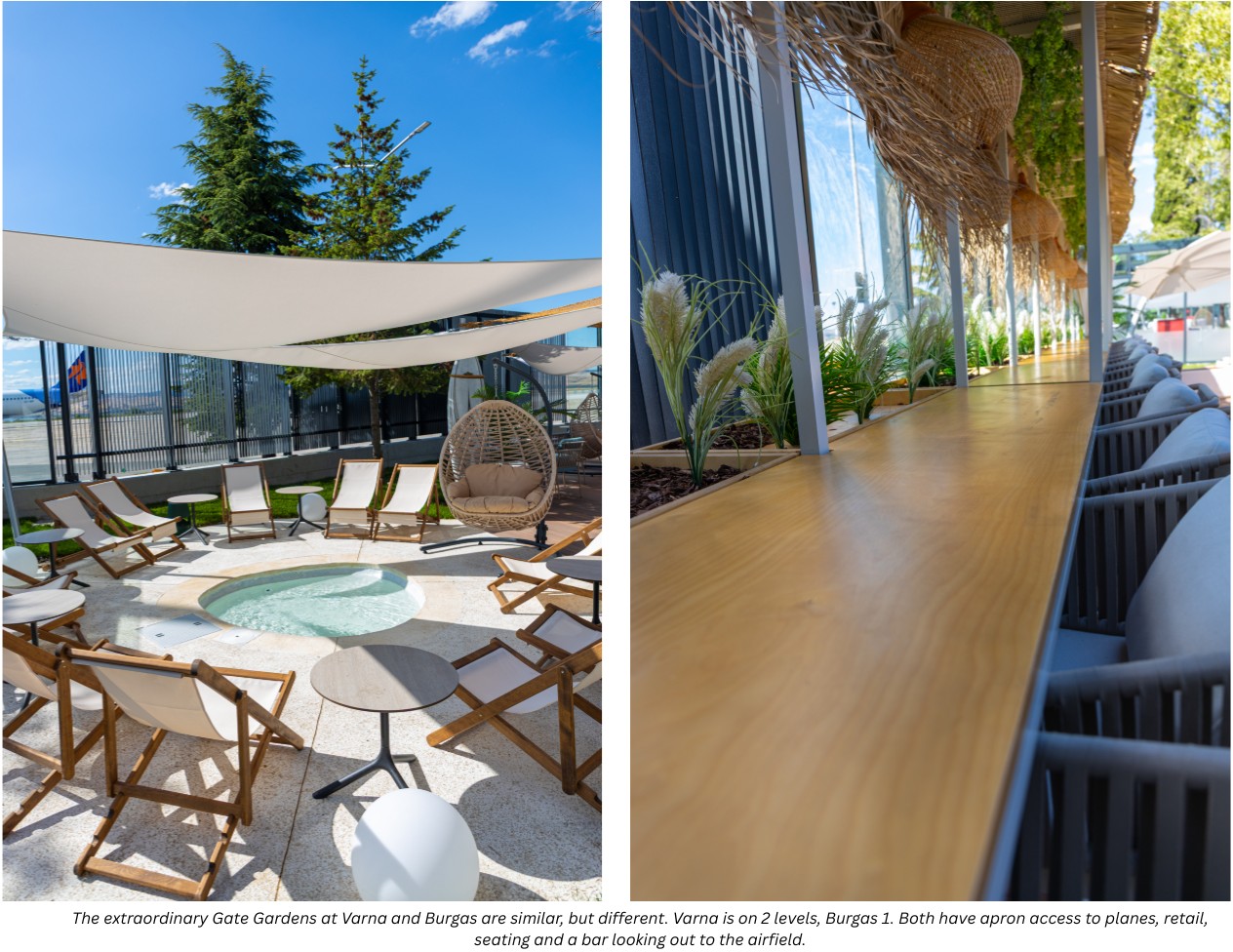
We put a lot of emphasis on what our passengers really want, so we followed their requirements. We listened to them. We provide an assortment that passengers would naturally expect at a touristic airport, plus quick service options at acceptable pricing levels. We are not offering something too fancy or a full-blown restaurant. That would not work given the quick turnaround of our airlines flying from here. Everything here needs to be smooth, fast and reliable.
PM: Well, your two principal partners here – Avolta and Lagardère – have certainly not cut back in terms of their investment either. Between you all, the bar has been dramatically raised. It’s world class in so many respects. How long are the concessions here normally?
MR: It depends, but it is usually up to 10 years plus/minus. We believe in long-term partnerships. Commitment and trust between parties is key.
PM: So what KPIs are you now using?
MR: It’s a classic approach: spend per pax and penetration. This is what we monitor, but we are also looking on an outlet-by-outlet basis and how they are performing.
I am sure there will be some important learnings with the commissioning of the new infrastructure – wayfinding and gate orientation are examples. I tend to say we have a eshoebox terminal concept here. It is really overseeable and you can experiment a lot within a small footprint, and this is what we definitely want to do.


The Schengen operations, introduced at the beginning of this year, have brought some challenges to the outlets, but we have worked hard to find adequate solutions.
PM: OK, so let’s move on to digital transformation of both airports. What’s been introduced that’s different?
MR: Good question.
To be frank, the use cases for AI at airports are at the moment rather limited. There are some examples, well-proven, that have been introduced. We have been doing a lot at Fraport to investigate what is the best fit and we are still on a learning curve. There are various ideas – cameras supporting automatic recognition of passengers flows to identify capacity bottlenecks and link it to resource planning to give an example. But you have to be very cautious about data protection policy. As our airports operate in the European Union, we are a bit handcuffed by these policies. Irrespective of this I do see AI offering a lot of potential. The question remains what are and will be the use cases though. Is it really making sense? If you are getting too far away from real operations and letting AI do the job, I’m not sure if it’s leading us in the right direction.
PM: I understand that both airports highlight efficiency and new apron solutions for sustainability. How will the actions taken work within the context of broader carbon reduction and environmental goals? And, as an airport, are you putting profitability ahead of sustainability?
MR: No, I think this can go hand in hand. When you look here at our solutions with the construction of two PV plants here, we are catching the sun in the summer where our peak traffic is. We can benefit a lot from just our own production. We started in Burgas this year with a 1.2 MV photovoltaic system targeting to cover a minimum of 25% of our annual energy consumption by photovoltaic energy.

At Varna, a comparable photovoltaic system is currently under construction, expected to save around 970 tons of CO₂ emissions per year. Combined with the Gate Garden, which alone reduces around 110 tons of CO₂ annually thanks to its natural cooling effect, we are moving firmly on our sustainability path.
And for ground handling equipment, we have a clear strategy to replace our GSE equipment with electrified equipment as compared to fossil-fuel equipment. Fossil-fuel utilities have higher life cycle costs since energy must be purchased, while our PV system provides nearly free energy through our own production.
So I think there is a huge potential in this segment, and it clearly follows our group’s strategy to be carbon neutral by 2045.
PM: Have you got storage banks?
MR: Not yet, but this is the next natural step. At this point in time, batteries are still quite expensive and would not justify an investment in a larger scale.
PM: Now, this winter, Burgas is set to undergo massive terminal redevelopment and faces a runway closure. How would you minimize operational disruptions and support your airline and commercial partners effectively through this pivotal phase of that airport’s development?

MR: So for us, the situation is not new, because when you look a bit more than 10 years back in time, we were in the same situation here in Varna. So we rehabilitated Varna Airport during a winter period, we closed the airport in its entirety, rehabilitated the runway and all of the traffic was relocated to Burgas.
And this time we are doing it vice versa, so Burgas will be closed and traffic will be relocated to Varna.
PM: I know we will be going into more detail on both Varna and Burgas airports respectively. But I would perhaps venture the following as the key differences – please correct me if I’m wrong. Varna seems to stand out for its dramatic Gate Garden, its open air shopping, immersive, family focused retail, and arguably that it provides a great additional experience to everyone’s holiday at this Black Sea destination.
In contrast, Burgas appears different because it has a bigger retail and food and beverage offer. Of course it also features a Gate Garden, but it is not exactly a clone of Varna and the passenger profile is different. It also has an airport museum. That was great fun to visit.
MR: To answer your question swiftly, we have adopted our retail and F&B concept to the passenger pattern. We have a much stronger non-Schengen operation in Burgas as compared to Varna. So there’s a clear focus in Burgas on this part. The Gate Garden is currently only accessible to non-Schengen passengers, as broader access wasn’t operationally feasible. In the future, we aim to open it to Schengen operations, offering a similar product to what we have in Varna.


The key differences? Burgas was designed to accommodate a few more passengers as compared to Varna. We have 31 check-ins there as opposed to 25 in Varna. Burgas has a clear, higher focus, a higher peak in the summer. This was traditionally like this, especially with the huge demand coming from Russia to visit Burgas, as compared to Varna.
MR: Varna itself was always having, let’s say, a more even traffic profile with a higher demand also in shoulder peak, whereas Burgas was having far less traffic in the winter season. We are trying to overcome this by attracting more airlines in the winter season. Honestly, the main demand will remain in the summer when Burgas hotels operate and tour operators offer Black Sea Coast holiday packages.
PM: So let’s talk about projected growth. You’re on a mission. You’ve been installed here to turn things around, to move things in the right direction. What are you forecasting for the next couple of years?
MR: A good question. We are forecasting growth and this can be only unlocked by convincing airlines to come here. Frankly speaking, as an airport manager, we cannot decide which airlines come here. We can only host them – it’s their decision whether to come here or not.
To give you a concrete example, at Varna Airport we have already served 953,000 passengers from January to July 2025, which is +17% year-on-year. For the full year, we expect around 1.9 million passengers – over 20% growth versus 2024 and already above 90% of 2019 levels, despite missing traffic from Russia, Ukraine, and Belarus.
For tourists to visit Bulgaria, the country must offer a competitive tourism product. Therefore, the tourism product must meet high standards and offer good quality. Prices needs to be attractive, too, as Bulgaria is competing against the the big players in the market – Turkey, Greece, Spain. To compete with those destinations, we need to improve the overall quality of Black Sea Coast hotels and offerings.
For this year we saw very positive signals.
Encouragingly, there are a lot of new four and five star hotels that have opened recently, and our guests are clearly recognising this when you ask them. Affordability of travel and accommodation is also key and this, combined with the outstanding beauty of the Black Sea coast, continue to make striking arguments to visit Bulgaria – irrespective of the short season, I would add. Our industry partners must continue investing in the infrastructure and in promoting tourism. We cannot stand still here.
To put it into perspective, the very price-sensitive German market is our top performing market in 2025, showing more than a fantastic 70% growth compared to last year. New routes from airlines such as Wizz Air, Bulgaria Air, Electra and SAS also demonstrate strong momentum. Eventually, we are on a very good path.


PM: Exactly right. So how much are you planning to invest in airports in the coming years?
MR: Investments in the Gate Gardens totalled around €20 million, including our partner’s contributions. In the nearer future, we intend to invest over €75 million in the airport infrastructure to upgrade or rehabilitate where needed.
PM: That’s a lot of money to commit to two small airports.
MR: Yes, it is a lot of money, and it has to be earned back. And it will not necessarily come from airlines, far more likely from non-aviation revenues.
PM One last question, Michael. If there are three things you want to say to the business community right now about the two airports, what would they be?
MR: Firstly, Partnership and good collaboration are paramount. We value stakeholder engagement and see our workforce as a key asset to uphold and maintain the service level quality that we have at the moment.
Secondly, we are participants in a value chain. To be sustainable, we must be profitable. We are not immune to market and environmental changes. As a profit-driven organization, sustainability depends on generating profit.
Finally, our core motivation is to boost traffic to the Black Sea Coast, increasing revenue for the company, our shareholders, and partners. This is the formula for shared success.












To subscribe free, please enter your email address: