


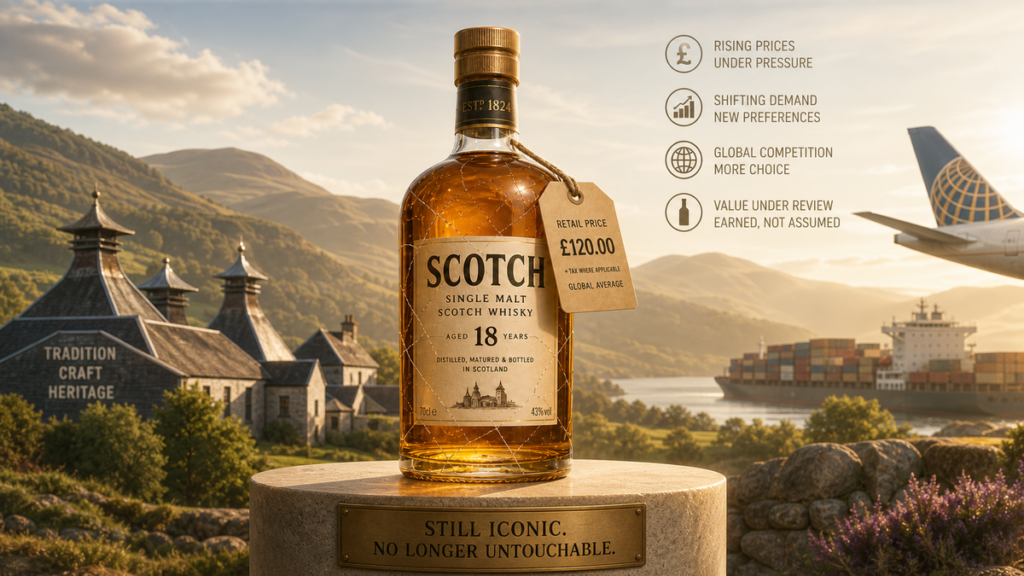
Still Iconic, But No Longer Untouchable: Scotch’s Reality Check


Scotch whisky has not lost its mystique. It still props up Scotland’s export story, still fills airport walls and still anchors more “luxury” backbars than any other brown spirit. Exports in 2025 came in at roughly £5.36 billion, the equivalent of around 1.34 billion bottles – a bottle leaving Scotland every second. Yet behind that heroic stat sheet sits a distinctly less heroic reality: export value slipped, volumes fell by over 4%, and one in five Scottish distilleries is now reported to be in financial distress. The United States caught a tariff cold, Asia Pacific stopped doing all the heavy lifting, and the premiumisation fairy dust has thinned. Scotch is not in crisis. But it is deep into a correction of its own making.
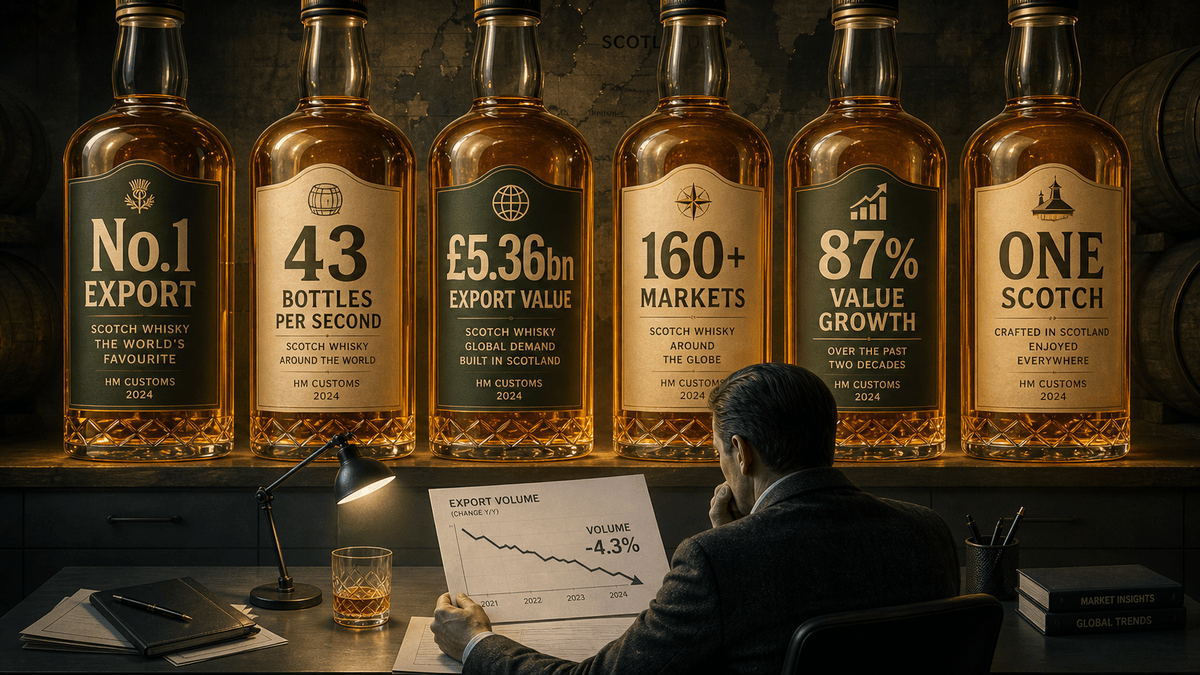
One of Scotch’s great skills has been its ability to weaponise big numbers. “World’s number one internationally traded spirit.” “Forty‑three bottles exported every second.” You can almost hear the slides advancing themselves. Those claims remain technically true. The export total is still north of £5 billion, and Scotch still carries a disproportionate share of Scotland’s export prestige on its shoulders.
What has changed is the direction of travel. The latest export figures show value slightly down and volume down more sharply. This follows a year in which volume held up better than price, which itself followed a pandemic period where anything in a decanter seemed to sell. The flattering story – “we’re huge and still growing” – has quietly given way to something more awkward: “we’re huge, but the market is starting to push back.” For a category that has largely behaved as if demand for premium Scotch is an inexhaustible natural resource, that shift matters.

Nothing reveals a house’s foundations quite like a good macro shock. For Scotch, that shock arrived in the form of a 10% tariff into its single most valuable market, the United States. Export data show the damage clearly enough: US value slipping, volumes down double digits in the months after the tariff, and the trade body estimating the impact in millions of pounds a week.
Naturally, the political fight has been noisy. Industry and government want the tariff removed; Washington wants leverage; everyone wants to claim credit when it eventually goes. But the deeper lesson risks being ducked. If a 10% price hit can knock the stuffing out of Scotch in the US, what does that say about how stretched some of those price points had become? Tariffs are an easy villain. They are less convenient as a mirror.
For years, Scotch treated the US as a bottomless, prestige pit – a place where you could raise prices, add another limited edition, another luxury collaboration, and assume the audience would follow. The tariff simply revealed how contingent that assumption really was.
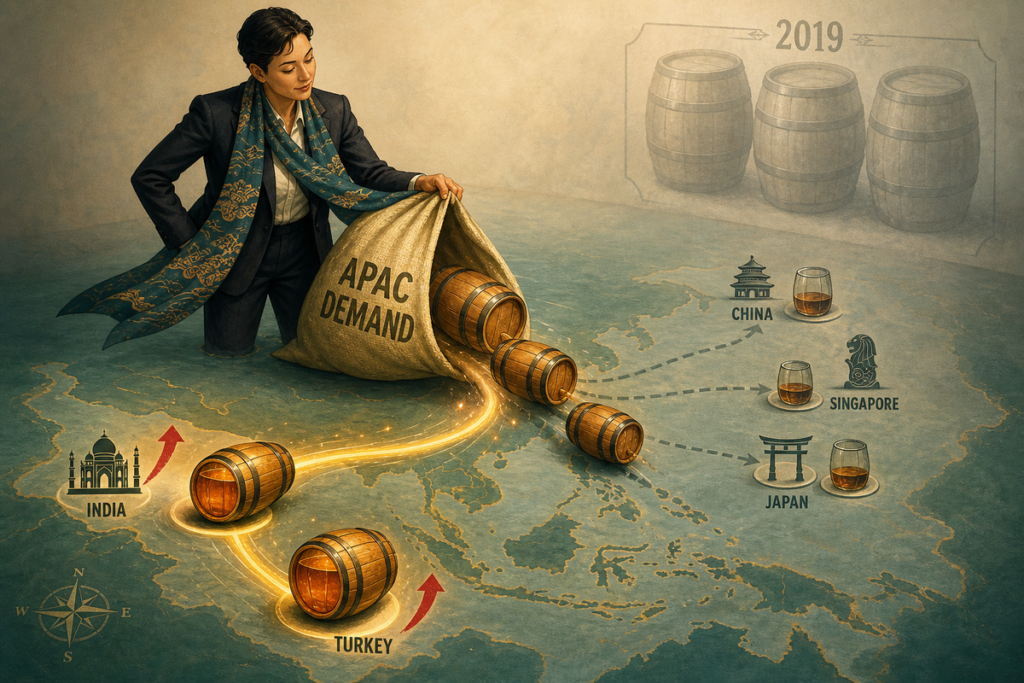
If the US has been Scotch’s most valuable market, Asia Pacific has been its favourite story. APAC has long been the region of breathless slides: rising middle classes, luxury growth, “status spirits” and double‑digit gains in China. Distillery investments, duty free line‑ups and global brand decks have all been built around that expectation.
It is therefore more than a rounding error when Asia Pacific’s Scotch import value drops while volumes broadly hold. That is trade‑down in real time: drinkers still buying whisky from Scotland, just at lower price points. Complicating the narrative further, other spirits continue to jostle for the same aspirational consumer – agave, Japanese, local single malts – with fresher stories and, in some cases, more believable value.
There are still genuine bright spots. Latin America has put together back‑to‑back years of growth. Turkey has gone from footnote to fascination. India has become the industry’s favourite “next big thing” again, helped by the prospect of tariff relief. But none of these markets, individually or collectively, can carry the weight of every distillery expansion, every prestige range and every premium dream that Scotch has commissioned for itself over the last decade.

Export lines are one thing; insolvency statistics are another. When restructuring firms start publishing lists of distilleries in financial distress, the conversation moves from “macro volatility” to “we may have built too much, too fast, at the wrong price.” Recent data suggesting that roughly one in five Scottish distilleries is now in financial difficulty – and that the number has risen far faster than the UK average for other sectors – should be ringing bells in every boardroom. That is a real concern.
Think about that against the official narrative. On the one hand: billions in exports, powerful branding, trade bodies talking about resilience and long‑term growth. On the other: a fifth of producers under stress, many of them having spent the last decade adding stills, warehouses and expensive visitor centres on the promise of endless premium demand. That tension is not sustainable. Either prices, expectations or the shape of the distillery landscape – and likely all three – will have to adjust.
Scotch has lived through a classic “whisky loch” before, when overproduction of faceless blends met changing tastes and brutal economics. This time the overreach sits uncomfortably close to the luxury end of the market. The pain will not be evenly distributed.
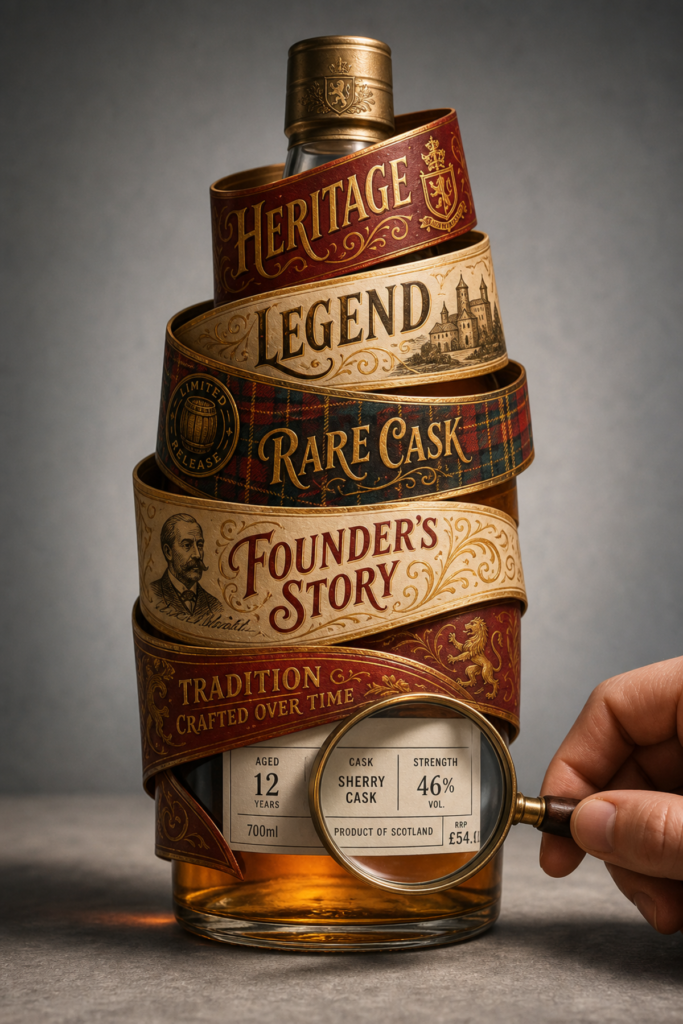
It’s fashionable to blame everything on tariffs, inflation and whatever label we’re currently giving to “consumer uncertainty”. But Scotch has to own its side of the bargain too. The category has spent a long time confusing storytelling with justification, assuming that surrounding a bottle with enough heritage, mist and copper stills, nobody will notice how thin the value logic has become.
Premiumisation, in principle, is simple: give the consumer a genuine step up in quality, character or experience, and charge appropriately. Premiumisation in practice has often looked more like this: same broad profile, slightly nicer box, more abstract cask story, materially higher price. That works when the consumer is in a forgiving mood and other asset classes are booming. It works less well when people examine their receipts closely.
In travel retail, the dynamic has been particularly stark. For years, the answer to “how do we grow” was “another airport exclusive” – frequently non‑age‑statement, wrapped in the language of rarity, and priced on the assumption that jet lag makes you bad at maths. The category has been brilliant at selling the idea of Scotch. It has been less brilliant at answering the basic question: “why this whisky, at this price, now?”

It’s important to stress what this is not. This is not the death of Scotch. The fundamentals – technical, cultural, symbolic – remain strong. The category still dominates global whisky consciousness in a way no rival has genuinely unseated. Consumers have not stopped liking Scotch. They have simply stopped accepting that “Scotch plus packaging equals any price you fancy.”
That is why “correction” is a more useful word than “crisis”. Corrections are painful, but they are also clarifying. They force you to separate what is robust from what was merely fashionable. In this case, that means distinguishing distilleries and brands that have genuine distinctiveness and sensible economics from those whose business model depended on an endless supply of status‑hungry collectors.
It also means accepting that some of the last decade’s expansions may have been vanity as much as vision. Not every distillery will, or should, survive in its current form. Not every travel retail range deserves its space. That is harsh, but it is a lot healthier than pretending a category can defy gravity indefinitely.

So what would a more grown‑up Scotch industry actually do?
First, it would get more honest about value. That doesn’t mean a fire‑sale. It means being able to explain, in plain language, why a particular bottle costs what it does. Age, cask type, yield, strength, provenance – all of that can be compelling if it is specific rather than mystical. The days of hiding behind “rare casks” and “secret recipes” should be over.
Second, it would dial down the volume of hyper‑premium noise. Not every release needs to be a “collectible.” Not every label needs a five‑minute film. There is real equity to be built in well‑made, fairly priced blends and age‑statements that feel like dependable treats rather than speculative assets. That middle ground is exactly what gets squeezed when a category loses momentum at the top.
Third, in travel retail, it would treat passengers as thinking adults, not captive wallets. That means fewer opaque exclusives and more ranges that help shoppers navigate flavour, occasion and budget. It means activations that educate as much as they dazzle. It probably also means being ready to support more realistic pricing without panicking about “brand erosion”.
Finally, it would accept that volatility is now the default, not the exception. Tariffs will come and go. Demand in China will swell and shrink. Status spirits will have good years and bad ones. The response cannot be denial and another limited edition. It requires a quieter confidence in the underlying product and a willingness to flex around it.
Scotch remains one of the drinks world’s great achievements. The current discomfort doesn’t change that. It just asks the industry a question it has managed to avoid for quite a while: if you strip away the mythology, is what’s in the bottle genuinely earning its place – and its price – in 2026?










To subscribe free, please enter your email address: