

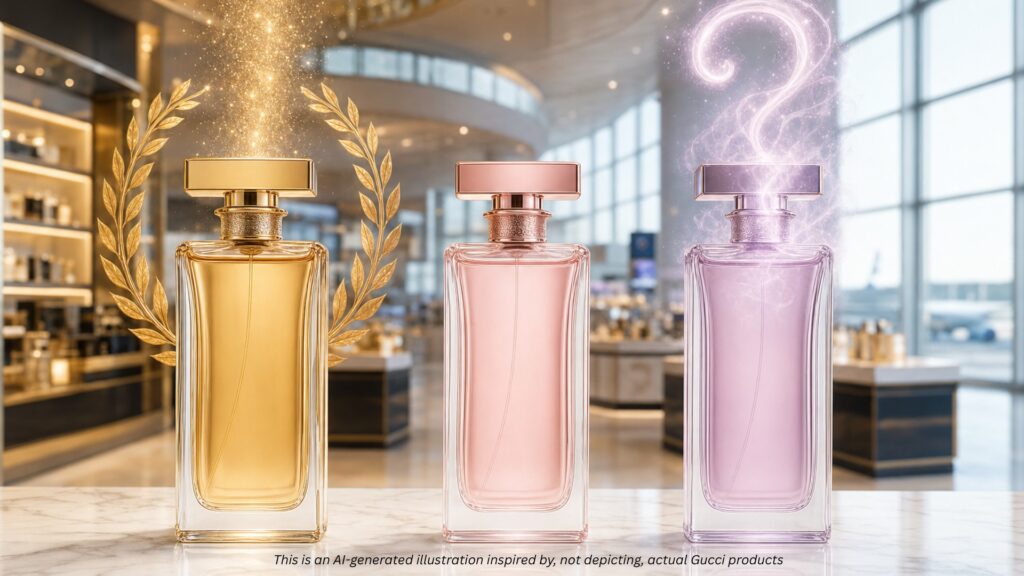
Three Houses – L’Oréal, Kering, Coty – One Bottle: What The Gucci Beauty Handover Really Means For Travel Retail (and other) Shelves. By: Peter Marshall


When Kering, L’Oréal and Coty issued near-simultaneous statements last week, most of the trade press appeared to file it as tidy corporate housekeeping. For travel retail, it is anything but. The early handover of the Gucci Beauty licence – brought forward a full year from its 2028 expiry – will redraw the fragrance wall in almost every major airport worldwide. And it leaves the channel with one clear winner, one house steady, and one facing a distinctly narrower future.
Make no mistake: this is L’Oréal’s moment. Having sealed its beauty alliance with Kering in October 2025, the company has now accelerated its prize, securing a fifty-year exclusive worldwide licence for Gucci fragrance and beauty from mid-2027. Half a century of control over one of prestige beauty’s most travel-retail-friendly names is unquestionably a generational asset.
L’Oréal Luxe already leads TR with Yves Saint Laurent, Prada and Armani. Adding Gucci Flora and Guilty gives it almost unrivalled scale in fragrances – more gondola negotiating power, more travel exclusives, more terminal activations. As we know, L’Oréal is a house that treats airports as a first-class launch stage – not a clearance channel. So, you can expect airport firsts, refill formats, and city-specific activations within two years of taking the keys. For operators, a much stronger Gucci is coming. It’s just not coming yet.
For Kering, this is less windfall than housekeeping done well. The group is shouldering the lion’s share of the early-redemption cost and, importantly, has folded a settlement of all the pending Gucci Beauty litigation into the arrangement. A year ahead of schedule, Gucci’s scent story now sits with a single, aligned partner rather than a reluctant one.
Kering remains a house in patient reconstruction, its Gucci fashion turnaround still effectively a work in progress. But this move clears an issue off the desk and hands the Florentine brand’s beauty future to the best operator in the business. For a group that has spent two years managing turbulence, “stable” is the right read. And stability is a strategy, The fragrance question has been answered and management can turn its full attention to the runway.
Then there is Coty, and here the mood changes. Officially, the roughly $400 million it receives is fuel for debt paydown and reinvestment for the likes of BOSS and Marc Jacobs But the subtext is harder to dress up: Coty was losing Gucci regardless, and it has chosen to take the cash now rather than run the clock to 2028.
For the travel-retail floor, the loss is real. Gucci has been one of Coty’s most recognisable fragrance pillars in the channel – a hero name that anchored bays and pulled in footfall. Strip this away, and Coty must now carry its duty-free credibility on BOSS, Burberry and Chloé. These are, of course, capable franchises with genuine traveller appeal. But, arguably, none of them commands the same substance of Gucci. The company’s own share price – now approaching multi-year lows and valuing the whole group at less than L’Oréal ascribed to a single Gucci licence – tells you how the wider market reads the handover. The plain fact is that the payment buys breathing room, it does not buy a growth story.
The short-term risk lives in the transition itself. Coty continues to operate Gucci Beauty through to at least 30 June 2027. This means the channel faces roughly eighteen months of a licence in transit – a window that historically breeds precious little product introduction and cautious stock commitments as neither the outgoing nor the incoming licensee will want to invest heavily.
However, once L’Oréal holds the licence in 2027, Gucci fragrance should return to the front of the travel retail fragrance category with the investment intensity its equity has always deserved. This can only be good news for airport retailers who have watched the brand underperform its potential.
So, at the end of the day, the picture is this: there is one clear winner, one steady(ing) survivor, and one house that has just parted with a key part of its identity to shore up its balance sheet. The bottle on the shelf may look unchanged, but the hands holding it – and the ambition behind it – have shifted for good.










To subscribe free, please enter your email address: