Where To Now For Estée Lauder? “Beauty Reimagined” After the Puig Non‑Deal


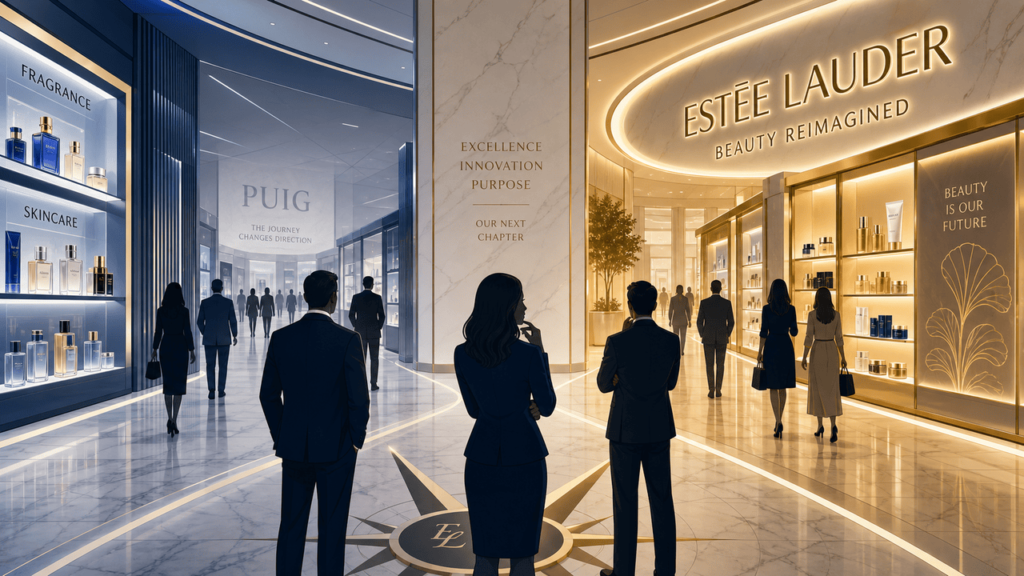
Estée Lauder’s decision to walk away from a potential tie‑up with Puig has effectively reshaped the conversation around one of beauty’s most scrutinised giants. For months, the prospect of a 40 billion dollar prestige powerhouse was taken as proof that Estée needed external help to fix its growth and execution problems. Instead, the company has now doubled down on its own “Beauty Reimagined” turnaround, asking investors, retailers and brand partners to believe that the cure lies within. Early numbers hint at stabilisation, not salvation. And the real question now is whether this reimagining can move from strategy to execution and P&Ls fast enough.
TRunblocked.com examines the key factors that will determine the success – or failure – of Estée Lauder’s ‘better untogether’ decision.
So, Estée Lauder’s decision to walk away from Puig has flipped the script. Instead of a struggling giant hunting for a saviour, it is now framing itself as an independent turnaround story under “Beauty Reimagined,” and investors – for now – are prepared to listen. The key issue is whether that reimagining can translate from strategy slides to counters, travel retail halls and P&Ls before the market’s patience expires.
When the Puig talks leaked in March, the reaction was brutal: billions were wiped off Estée Lauder’s market value in days as investors fretted about overpaying for growth and complexity. The narrative was that Puig – freshly IPO’d, fragrance‑heavy, growing – would bolt onto a structurally slower, more troubled Estée to create a $40 billion-plus prestige beauty colossus. But it also screamed “defensive merger,” not brand‑led vision.
Fast forward to May and the mood music changed entirely when the companies ended talks. Estée Lauder’s shares jumped double digits on the news, while Puig’s slumped – signalling that investors now prefer Estée to fix itself rather than gamble on a mega tie‑up. In effect, the market has said: you don’t need Puig if you can execute your own plan. But the grace period will be short.
“Beauty Reimagined” is Estée Lauder’s attempt to put structure around that plan. It essentially revolves around four pillars: a slimmer, more regionalised organisation; a sharper brand and category focus; heavy cost cutting; and targeted reinvestment into growth channels, markets and price tiers.
Operationally, the group is consolidating into four regional clusters and reorganising its portfolio so that brands sit in tighter, category‑led groupings intended to speed up innovation and decision‑making. Alongside that, it is cutting roughly 5,800 to 7,000 jobs (about 10% of the workforce) and targeting up to $1 billion in annual savings by fiscal 2027, with a meaningful chunk earmarked for advertising and consumer‑facing activity. The promise is a company that is leaner, faster and more consumer‑centric, without sacrificing its prestige glow.
So far, the numbers suggest stabilisation rather than a slam‑dunk recovery. Estée Lauder has returned to low, single‑digit sales growth, with signs of share gains in certain focus areas and the first operating margin improvement in several years. Management has flagged fiscal 2026 as a “pivotal year” – effectively focusing more on building a foundation than delivering fireworks.
The backdrop, as we know, is a sequence of misssteps: inventory overhangs, a bumpy China recovery, and uneven performance in key engines like travel retail. Against that, a controlled return to growth and margin expansion is more than welcome – but it is hardly enough to declare the turnaround complete. The investor lens is now: can this move from “less bad” to become genuinely competitive against L’Oréal, LVMH, Shiseido and a swarm of fast‑moving independents?
In reputational terms, walking away from Puig has been accretive. Estée Lauder is no longer being discussed as a trophy asset to be “fixed” inside someone else’s portfolio. Instead, it is back to being judged on its own ability to streamline, innovate and grow. The stock’s whiplash – punished when the talks were confirmed, rewarded when they died – underlines just how nervous investors were about an expensive, distracting deal layered on top of an unfinished self‑help story.
There is, however, no blank cheque. The current mood is one of caution: if “Beauty Reimagined” delivers, then the upside lies in margin rebuild and renewed brand momentum. But if execution stalls, real pressure on Estée’s share price and/or the need for fresh deal‑making will undoubtedly resurface quickly.
Structurally, Estée Lauder still sits in an enviable place in global prestige beauty. It owns some of the world’s most recognisable skincare and makeup franchises, has deep retailer and travel retail relationships, and can play across price tiers and categories in a way few rivals can match. The current re‑organisation aims to turn that scale into agility: fewer organisational layers, closer proximity to consumers, and faster responses to trends from clinical skincare to niche fragrance.
Yet the fault lines are obvious. Execution in China and travel retail has seriously lagged expectations, offering competitors plenty of room. Large-scale headcount reductions and supply chain simplification are culturally and operationally risky – precisely when creativity, local nuance and speed are critical. And the competition – from L’Oréal and LVMH to ambitious middle market brands – is not standing still, particularly in science‑backed skincare and digitally‑driven brand building.
Whether Estée Lauder’s reimagining “works” depends on how success is defined. A realistic target looks more like a grind back to respectability: sustained low-to-mid-single-digit growth and a step‑by‑step rebuild of margins into the low double digits. This looks far more likely than a quick return to peak pandemic‑era profitability. That outcome is plausible – if cost savings materialise on time, Asia and travel retail normalise, and the group’s innovation and marketing engines rediscover their old sharpness.
These are big “ifs”.
What has changed post‑Puig is the symbolism. By formalising a multi‑year self‑help plan, taking visible pain upfront and refusing a mega‑merger on less‑than‑compelling terms, Estée Lauder is signalling to retailers, brand partners and shoppers that it still sees itself as a category leader, not a consolidation target. In prestige beauty – where confidence, narrative control and consistent brand stewardship matter almost as much as the formula in the bottle – that positioning alone buys time. But the real test will be whether “Beauty Reimagined” acutally shows up – not just in earnings, but in fresher innovation, cleaner inventories and much sharper execution in the channels that matter.


To subscribe free, please enter your email address: