

Travel Retail: Conversion Driver or Conversion Dead Zone? Why Travel Retail Must Design for Effortless Exploration.


I thought this a particularly appropriate and sharply insightful feature by Garry Stasiulevicuis, Managing Director Shelftrak, to publish ahead of this week’s Trinity Forum gathering in Doha. This may make uncomfortable reading for some, but it is exactly on point, where fundamental rethinking by this industry is required.
As we all know, travel retail excels at theatre.
Walk through any major international airport and the ambition is unmistakable: dramatic lighting, premium materials, oversized hero promotional points and immersive brand storytelling. These spaces are designed to impress, to elevate brands and to turn airports into global showcases.
And visually, many of them succeed.
But beneath the spectacle sits a growing commercial disconnect.
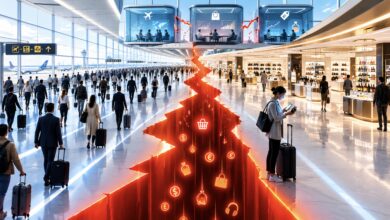
Because, while travel retail invests heavily in retail theatre, too many stores are quietly becoming conversion dead zones – places where shoppers enter with intent, curiosity and openness, but struggle to navigate the offer, lose confidence, and leave without buying as much as they could.
The issue is not footfall.
It is not lack of interest.
And it is not a failure of creativity.
It is a failure to align retail execution with how shoppers actually think, explore and decide.

How Shoppers Really Decide and Discover
Across FMCG retail, research has long agreed on one foundational truth:
Up to 70% of purchase decisions are made in-store (Nielsen, POPAI, M1ndset).
What matters just as much is how those decisions are formed.
Many observational studies show that shoppers scan shelves for only a few seconds before mentally filtering out most options. Nielsen and Ehrenberg-Bass research consistently shows that shoppers rely on fast visual cues, familiarity and mental shortcuts, not extended evaluation, to decide.
This is System 1 thinking in action:
Shoppers don’t compare everything on shelf. They notice a few things, feel drawn to something, and then either lean in or move on.
This matters enormously in travel retail.
The Travel Retail Mindset: Open, Curious… and Cognitively Loaded
One of travel retail’s great advantages is that shoppers arrive in a different mindset to domestic retail.
Industry research consistently shows that airport shoppers are:
But here’s the critical nuance:
Shoppers want to explore — but they want exploration to be effortless.
Exploration does not mean patience for confusion. It does not mean tolerance for clutter. And it does not mean a willingness to decode overcrowded shelves.
At the same time as openness to discovery increases, cognitive load also rises.
Many industry research studies highlight that airport shoppers are:
Research repeatedly identifies lack of time and difficulty finding products as two of the most common barriers to conversion.
So while shoppers are curious, they are also mentally constrained.
Exploration must therefore be guided, intuitive and visually clear — or it collapses.
Why Effortless Exploration Matters More Than Speed
It would be wrong to characterise travel retail shopping as purely rushed or purely functional. Many shoppers do linger. Many do browse. Many enjoy the experience.
But behavioural psychology shows that even exploratory shopping relies on fast, intuitive processing.
Exploration is emotional, not analytical.
Shoppers want to:
They do not want to:
When cognitive effort rises, exploration shuts down.
In those moments, shoppers default to familiar brands, safe choices — or abandon the category altogether.
When Retail Theatre Undermines Discovery
Retail theatre is supposed to support exploration. Too often, it does the opposite.
The shopper journey frequently looks like this:
This is how retail theatre unintentionally creates conversion dead zones.
Research consistently shows that ease of navigation and product findability are among the strongest drivers of conversion in airport retail. When these fail, curiosity turns into frustration.
Over-Ranging: When Discovery Is Buried, Not Enabled
Shelftrak’s SKU-level tracking across 70 airports and 100 stores globally shows that many categories are now over-ranged well beyond what supports either conversion or exploration.
Gin: Variety That Obscures Innovation

Shelftrak data shows:
In theory, this should support exploration.
In practice, it does the opposite.
At these densities:
From a shopper psychology perspective, genuinely new or distinctive SKUs are harder to notice, not easier. Innovation is buried in noise.
Over-ranging doesn’t create discovery. It hides it.
Malt Whisky: Where Choice Is Essential — and Balance Is Everything
Malt whisky is the category most often cited when defending large assortments in travel retail – and rightly so.
Unlike many other categories, malt whisky genuinely benefits from range depth. Shoppers expect to browse. They want to explore age statements, distillery styles, cask finishes, regions and price tiers. For many travellers, airports are one of the few environments where discovery, comparison and indulgent browsing feel not just acceptable, but encouraged.
This is a category where choice matters.
Shelftrak’s data supports this. Malt whisky consistently commands a significant share of shelf space in travel retail, reflecting its importance to both retailers and brands. Globally, the average malt whisky range sits at around 140 SKUs per store, rising to 160+ SKUs in many Asian locations where demand for premium and collectible whisky is strongest.
In principle, this makes sense. A narrow whisky range would undermine the category and frustrate its most engaged shoppers.
However, Shelftrak’s data also reveals where the balance begins to break down.
In several major travel retail locations, malt whisky assortments now exceed 200–250 SKUs. At this point, the range often stops functioning as a curated library and starts to resemble an unstructured archive. The issue is not that there is “too much whisky”, but that the structure supporting exploration collapses under its own weight.
Even in exploratory categories, shoppers do not process unlimited choice. Behavioural research shows that while enthusiasts enjoy browsing, they still rely on visual grouping, clear signposting and intuitive segmentation to make sense of complex ranges. When those cues are weak or absent, exploration becomes effortful rather than enjoyable.
Shelftrak’s shelf-level analysis shows that in any category where large ranges exist:
This is where effortless exploration becomes critical.
Done poorly, it risks becoming a conversion dead zone, not because choice exists, but because choice is no longer curated.
Confectionery: Impulse Undermined by Density
Even impulse-led categories are not immune.
Shelftrak data shows:
Impulse relies on immediacy and emotional trigger. Dense shelves slow both.

The Commercial Consequences of Making Exploration Hard
This is not just a shopper experience issue. It is a growth issue.
Retail studies consistently show:
Shelftrak analysis repeatedly shows that stores with:
outperform comparable stores with larger, denser assortments.
From a behavioural standpoint:
When shelves are overcrowded, shoppers explore less — not more.
Travel Retail Theatre, Reimagined
The answer is not less theatre and amazing retail, it’s theatre and retail that is designed to guide, not overwhelm.
Retail works when it:

Designing for the Modern Travel Retail Shopper
Designing for today’s shopper means accepting one uncomfortable truth:
Retail success is not about showing everything. It’s about making discovery feel easy.
What This Means in Practice
For Retailers:
For Brands:
Final Thought: Retail That Converts and Inspires
Travel retail has extraordinary advantages: premium shoppers, global visibility and permission to be bold.
But so many research studies all point to the same underlying truth:
Shoppers explore intuitively, decide quickly, and disengage when effort rises.
Retail theatre only works when it supports effortless exploration.
When it doesn’t, it becomes a conversion dead zone – visually impressive, commercially fragile, and quietly inefficient.
The future of travel retail will belong to those who stop mistaking abundance for discovery, and start designing theatre that helps shoppers notice, explore and decide with confidence.
Because in travel retail, exploration thrives on clarity – not clutter.











To subscribe free, please enter your email address: