

The Missing Cannes Conversation. By Garry Stasiulevicuis, Managing Director, Shelftrak.


Travel retail keeps asking for more data. It should really start acting on the evidence already sitting on the shelf.
Cannes is where travel retail goes to talk about the future. New products. New activations. New partnerships. New formats. New technology. New ways to personalise the passenger journey.
And, no doubt, the perennial Cannes demand will be made again: we need more data sharing.
It will be applauded. It will be repeated. It will not happen.
Not at the scale imagined, and certainly not quickly. Commercial sensitivities, incompatible systems, concession structures, supplier and retailer politics and the entirely rational reluctance to surrender advantage will see to that.
Travel retail has been calling for a grand data-sharing solution for years. At some point, an unanswered request stops being a strategy and becomes a ritual. More importantly, waiting for perfect data has become a very convenient excuse for avoiding the evidence already in front of us.
The industry does not need another dashboard before it can fix a missing priority SKU, remove a duplicate, correct a broken price ladder, simplify a weak promotion or restore the facings agreed with a retailer. It needs the commercial nerve to act.
This is a very timely op-ed from Garry Stasiulevicuis.
The Traffic Is Back. The Shopper Is Not
Airports Council International forecasts 10.2 billion passenger journeys in 2026, up 3.9% year on year. The traffic engine is running. Retail engagement is not keeping pace.
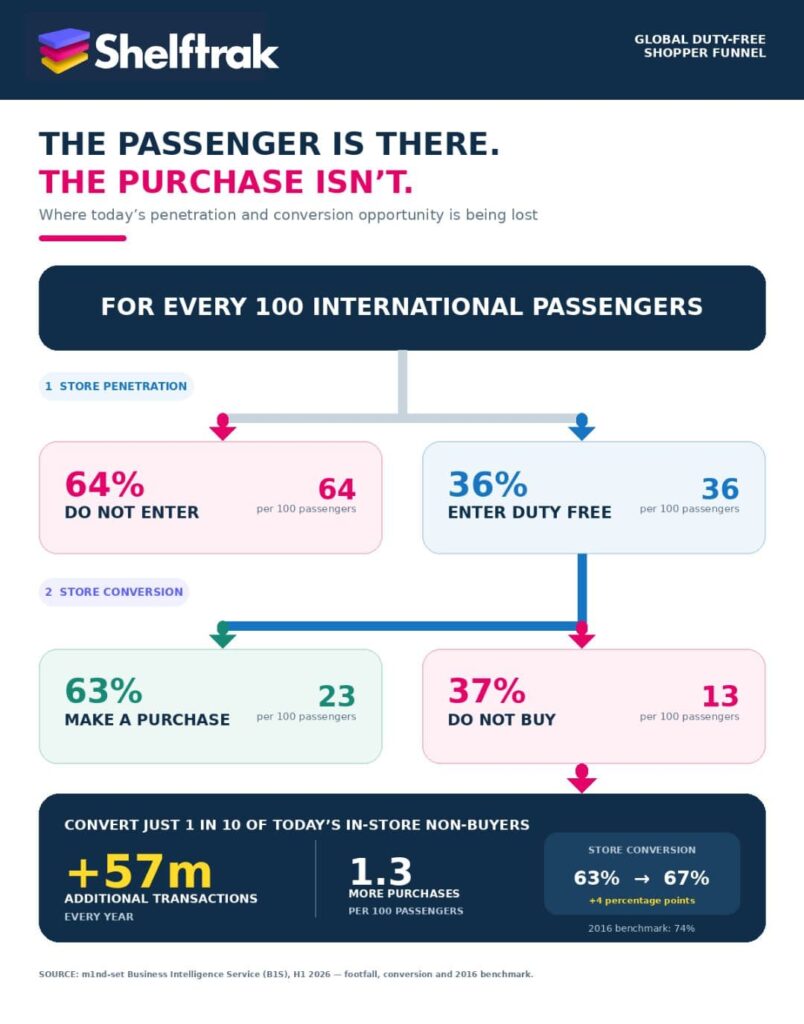
m1nd-set’s ten-year analysis of international travellers puts global duty-free footfall at 36% in the first half of 2026. Of those who enter, 63% buy. That leaves 64 in every 100 international travellers outside the store, and a further 13 who enter but leave empty-handed. Overall purchase penetration is only about 22%.
Conversion has recovered from its pandemic low, but it remains well below the 74% recorded in 2016. In other words, the channel has more passengers than ever and converts a smaller share of the people it persuades to walk through the door than it did a decade ago. That is not a traffic problem. That is a retail problem.
The arithmetic is deliberately simple. Convert just one in ten of today’s in-store non-buyers and conversion rises from 63% to roughly 67%. Applied directionally this equates to millions more additional transactions. It is an illustrative scenario, not a sales forecast. But it shows the scale of what the industry calls a marginal improvement.
One more shopper in every hundred is not marginal when the denominator is global aviation.
The Biggest Controllable Opportunity Is Already in the Store
Pi Insight’s latest Global Shopper Database reinforces the top-of-funnel challenge. Among travellers who do not visit duty free, 24% say they have no need to buy, 19% say they do not have enough time, 17% simply want to reach the gate, 16% cannot carry anything else and 15% prefer to shop outside the airport.
That narrow spread matters. There is no single magic activation that fixes footfall. Some barriers are behavioural. Some are operational. Some sit beyond the direct control of a brand or retailer.
Inside the store, however, the levers are visible and controllable. Range. Availability. Space. Price. Promotion. Visibility. Staff. Basic retail.
This is the missing Cannes conversation. Footfall may be the larger theoretical prize, but execution is the largest opportunity the industry can start capturing on Monday morning.
The Shelf Is Telling on Us
Shelftrak’s role in this debate is not to claim that shelf data replaces sales data. It does not. Sell-out explains what happened. Shopper research helps explain who has bought and why. Store-level execution data shows whether the conditions for success existed in the first place.
When those views are combined, growth opportunities can be identified, prioritised and quantified for the brand, the retailer and the total market. Even without universal data sharing, the physical store is already producing evidence. And some of it is deeply uncomfortable.
Example One: Choice Has Become Camouflage
In one major store at a leading Middle East hub, Shelftrak recorded 190+ chocolate-sharing SKUs. Of those, 121 were priced between US$10 and US$20. At a specialist confectionery store in a major Asian hub, 107 of 175 sharing SKUs sat in the same price corridor.
In both locations, more than 60% of products were competing inside essentially the same price band. Different brands and flavours can create real choice, of course. But 100-plus products chasing a similar mission, shopper and price point is not abundance – it’s duplication.
Travel retail treats range expansion as progress by default. It is not. If the next SKU does not recruit a new shopper, unlock a new occasion, create a credible price step or offer a genuinely distinctive proposition, it is not adding choice. It is dividing attention.
That is not innovation. It is duplication wearing innovation’s clothes.

Example Two: Promotion Has Become Wallpaper
The promotional picture is worse. At a key Asia location, 77% of observed alcohol SKUs were on promotion. At a key Korean location the figure was 70%. At one of India’s biggest airports, promoted products represented 42% of alcohol SKUs but occupied 70% of measured shelf space.
These are execution snapshots, not proof that every activity failed. Some offers will have been productive. Some space allocations may have been entirely justified. But when seven products in ten are promoted, ‘promotion’ stops signalling urgency. The offer is no longer the interruption. It’s just become the shelf.
The industry cannot keep confusing the volume of promotional communication with the volume of incremental sales. A red ticket is not evidence. A gondola end is not evidence. A photograph of an activation on launch day is definitely not evidence (But oh how the trade love’s them).
If the activity recruits buyers, drives incremental units and protects the price ladder, repeat it. If it merely subsidises purchases that would have happened anyway, it is margin leakage with some pretty signage.
 Example Three: A Listing Is Still Not a Launch
Recent Shelftrak tracking of 16 significant alcohol launches across 90+ monitored stores found distribution ranging from 88% for the strongest global launch to below 10% for another. Some launches will have been intentionally selective, so the figures must be assessed against their intended store universe. The underlying point remains: an announcement in Cannes is not a launch in the eyes of a shopper.
A listing is permission to compete. Distribution creates the opportunity. Visibility and availability and ultimately a product in a basket decide whether the opportunity survives.
Innovation without execution is just expensive inventory.

One Estate. Millions Hiding in Plain Sight
The commercial cost is not theoretical. In a recent diagnostic for a major brand owner, gaps in distribution, space, pricing and promotion added up to a multi-million-dollar annual sales opportunity across one regional estate.
That figure was not a promise that every dollar would be recovered. It was a prioritised opportunity model: where the execution gap existed, which lever was responsible and where action should start. That distinction matters. The industry does not need inflated claims. It needs a ranked commercial action list.
While Cannes debates the next million-dollar launch, another million may be leaking from range, space, price and promotion decisions already in markets across the globe. The glamorous investment gets a press release. The recoverable loss gets a spreadsheet – if anyone bothers to measure it.
The Traveller Does Not Shop the Average
Averages make a messy estate look well managed.
A regional price average can appear sensible while the same product is overpriced against a relevant alternative in one airport and underpriced in another. A category can gain facings globally while strategic stores cut it. A launch can achieve respectable distribution while disappearing into a crowded fixture. A promotion can look disciplined at market level while one terminal turns most of the aisle into an offer.
Management sees the average. The traveller shops one store.
This is why store-level measurement is not an obsession with granularity. It is where commercial accountability begins. Airport by airport. Store by store. SKU by SKU. Facing by facing. Most CPG companies in travel retail see the majority of sales from 100 locations. This is not a Tesco or Carrefour with hundreds or more outlets to manage – it’s small, pointed and can be a sensible focus for change.
Stop Waiting for the Perfect Data Set
To be clear, better data sharing would help. Brands need retailer sell-out. Retailers benefit from richer brand and shopper insight. Airports need a clearer view of how commercial decisions influence the passenger journey. The industry’s perennial Cannes request is directionally correct.
It is also not going to save us.
There will be no morning when every partner suddenly opens every system, agrees every definition and shares every commercially sensitive line. The barriers are structural, not technical. Waiting for that day means accepting today’s leakage indefinitely.
The answer is not to abandon collaboration. It is to stop making universal data sharing a precondition for action. Use the evidence available now. Make the assumptions explicit. Triangulate shelf, sales and shopper data where access permits. Measure the intervention. Learn. Scale what works.
At Shelftrak, that means using observable store data to identify the gaps, prioritise the locations and quantify the realistic opportunity, not simply for a supplier to steal share, but to grow the total market through a store that is easier to shop, more credible on value and more disciplined in its use of space. Shelftrak is not the story. The opportunity is.
Cannes Should Ask a Harder Question
Cannes should continue to celebrate innovation. Travel retail needs discovery, exclusivity and experiences that domestic retail cannot easily copy. But the industry has allowed ‘new’ to become a substitute for ‘better’.
So yes, ask what we should launch next. Ask how AI will reshape the journey. Ask for more collaboration and more data sharing, if everyone still feels obliged to.
Then ask the question that actually makes people uncomfortable:
What value are we already paying for yet failing to capture?
Which priority products are missing? Which SKUs no longer earn their space? Which promotions are changing behaviour and which are simply giving margin away? Where is the price ladder broken? Which launches were celebrated globally but barely executed locally? Who owns the corrective action, by when, and how will we know it happened?
That is the conversation capable of producing growth now. Not another pledge. Not another panel conclusion that the answer is ‘more data’. A quantified store-level plan, an owner, a deadline and proof.
Travel retail’s next great growth opportunity may be announced in the Palais but the biggest controllable one is already sitting on a shelf at an airport somewhere in the world.
The uncomfortable question is whether anyone is prepared to act.
Data sources and notes
Industry statistics: ACI World Airport Traffic Forecasts 2025–2054 (released 28 January 2026); m1nd-set B1S ten-year duty-free shopper analysis; and Pi Insight Global Shopper Database. Store examples are Shelftrak observed-shelf snapshots and measure physical execution rather than sales. The 31 million transaction illustration applies reported 2026 footfall and conversion rates directionally to 2.3 billion forecast international departures and assumes conversion of 10% of current in-store non-buyers; it is a scenario, not a forecast.












To subscribe free, please enter your email address: