


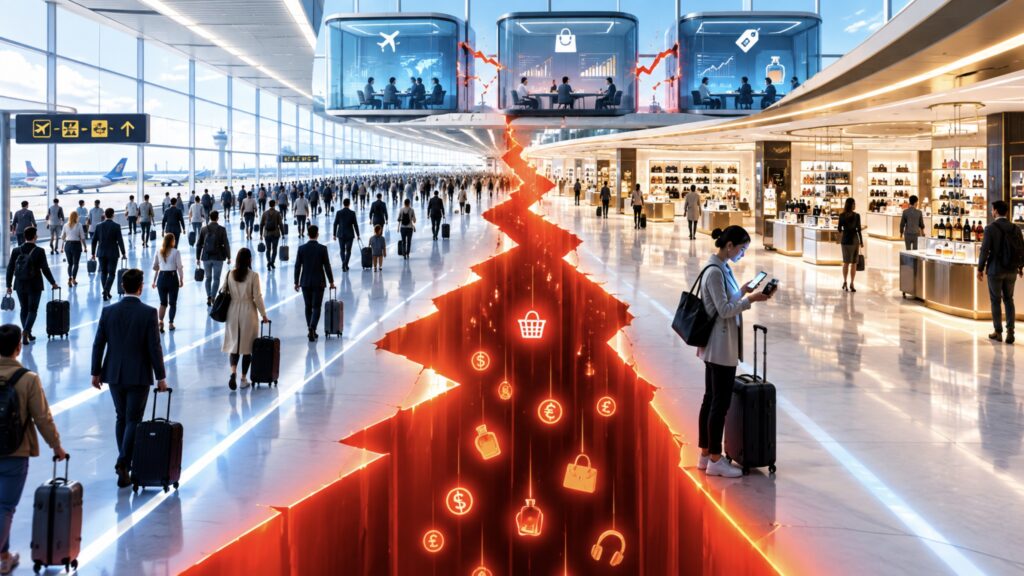
Full Terminals, Empty Promise? Travel Retail Really Does Have A Customer Problem.


Travel retail has a habit of mistaking movement for momentum. Airports are fuller, new stores are opening and passenger numbers certainly provide a reassuring headline. But the traveller is still proving harder to convert. That should seriously worry an industry built on turning transit into transaction. The uncomfortable possibility is that travel retail’s problem is not demand, nor even digital disruption. It is a commercial system that still rewards footfall, rent and retail theatre far more than it rewards customer value. The reckoning can no longer be postponed.
This article is unapologetically strong in its content. It sets out to provoke actionable talking points. There seems to be an almost wilful blindness coming from all parties. It’s simply time for this industry to get a much firmer grip on its core issues.
Travel retail has spent the past few years celebrating the return of the passenger. And there’s good reason to do so. International travel has regained much of its momentum, airport investment has resumed, brands continue to support the channel and some hubs are setting fresh benchmarks for retail ambition.
But passenger recovery is an aviation achievement. It is not automatically a retail one. That distinction should now be central to the industry’s thinking.
A fuller terminal can still mean a weaker retail proposition. More people may be moving through airports, yes, yet conversion, spend per passenger and basket quality remain uneven across markets, categories and passenger groups. The traveller is back – but they are not necessarily behaving like the shopper on which the traditional airport commercial model was built.
Travel retail does not have a footfall problem. It has a customer problem.
A full terminal is not a full till
Passenger traffic is an essential airport measure. It drives airline capacity, terminal utilisation, security deployment, food and beverage, lounge demand and the wider rhythm of airport life. But it does not guarantee retail performance. As we all know, a passenger moving through an airport is not automatically a customer. They may check in online, pass through security more quickly than ever, head for a lounge, eat before boarding, take a work call or spend their waiting time on a phone. They may be travelling short-haul with little dwell time. They may be managing children, looking for the gate or simply attempting to get through a delayed journey with minimum fuss.
They may also have concluded that the airport has nothing they need. That is the harder truth behind the numbers. Travel retail still likes to celebrate the measures that flatter it – passenger growth, route expansion, new square metres, glamorous flagship stores and high profile activations. All are signs of confidence. None, however, answers the commercial question that matters most: are travellers choosing to shop, or merely walking through a more polished commercial environment?
If passenger volumes increase while conversion, spend per passenger and basket value lag, the industry is not simply experiencing a delayed recovery. It is being told that an old formula is losing its reliability.
The customer has options. The system has habits.
Travel retail’s historic proposition was powerful for good reason. It combined international brands, product discovery, a (supposedly) privileged price, a captive audience and, in many cases, time to browse.
But the traveller’s relationship with retail has changed. The customer now arrives with a phone full of alternatives. They can check prices in seconds. They can compare a fragrance, a bottle of Scotch whisky, a beauty set or luxury accessory against brand websites, domestic stores, marketplaces and home delivery offers. They may well have already researched the product before leaving home. They may even have it in an online basket. The airport shop is no longer necessarily the beginning of the customer journey. It is often the final – and entirely optional – moment in it.
That makes the old reliance on “duty free” increasingly precarious. The term still has power, of course. For many travellers, it signals indulgence, gifting, discovery and a practical opportunity to replenish favourites. In the right market, with the right product and a clear price advantage, duty free remains highly compelling.
But the label is not the proposition. The proposition is whether the traveller sees real value. And that value could be price, convenience, access to a genuine exclusive, expert service, personalisation, gifting, local relevance or simply a better, faster purchase than they could make elsewhere.
Too often, the channel confuses visibility with relevance. A larger logo, a grander space or a more elaborate digital installation may generate attention. It does not automatically create desire. And if the principal output of an activation is an impactful image for a post-event report, that is not a retail strategy. It is merely a production cost.
The contradiction at the centre
The plain truth is that travel retail has a contradiction that it is increasingly difficult to ignore. The industry demands innovation from retailers while commercially penalising them for taking risks. It’s a given that airports face legitimate pressure to protect non-aeronautical income. They have major obligations around infrastructure, security, resilience, capacity, sustainability and passenger service. They cannot casually expose vital revenue streams to commercial uncertainty.
Retailers face a different, but equally real set of pressures: high fixed costs, staff recruitment and training, stock risk, supply chain uncertainty, expensive fit-outs, technology investment and passenger flows that can change rapidly due to route cancellations, airline decisions, currency shifts or geopolitics.
Brands, meanwhile, are asked to provide product, people, investment, exclusives and activation budgets while protecting domestic pricing, e-commerce strategies and wider distribution relationships.
Each party has a reasonable case. But the collective result is often a model where the retailer is expected to fund innovation, carry stock, staff the offer and absorb much of the downside – while the wider airport ecosystem benefits from a stronger passenger proposition.
An airport that says it wants retail innovation but will not share commercial risk is not seeking a partner. It is seeking a tenant with better ideas and the same old liability. That may sound uncomfortable. It is.
Partnership theatre is not partnership
Our business uses the word partnership constantly. Airport partner, retail partner, brand partner, strategic partner. But a shared launch picture is not a real partnership. Nor is a conference panel, a joint press release or a steering group that takes six months to approve a small pilot.
A partnership involves shared exposure.
It means data that is genuinely available, not rationed according to commercial leverage. It means joint investment in the digital journey, fulfilment, staff capability, retail technology and customer insight. It means faster testing, properly designed trials and clear agreement on how success will be measured.
It also means agreeing, before the pilot begins, who carries the consequence if it does not work. That does not mean every concession should become a joint venture. Nor should airports become retailers. In many markets, conventional concession structures remain valid and appropriate.
But a more difficult question needs to be asked: are airport, retailer and brand incentives sufficiently aligned to create a retail proposition that a modern traveller will actively choose? In too many cases, the honest answer is no.
This is why more flexible revenue share agreements, profit share arrangements, co-investment structures and – in selected circumstances – airport/retailer joint ventures deserve more than polite interest. They are practical ways to align decision-making around long-term value rather than short-term contractual certainty.
Such models do already exist, of course. Lagardère Travel Retail and Lima Airport Partners, for example, have used a profit-sharing duty free agreement designed to align their long-term commercial interests. And, more recently, Lagardère and local partner HSC Group secured a 12-year retail contract at Cambodia’s new Techo International Airport under an innovative profit-sharing model.
The China debate simply misses the point
China remains strategically vital to travel retail. It will continue to influence luxury, beauty, spirits and airport retail well beyond the present recovery period. Any business that dismisses the opportunity would be making a serious error. But the industry’s recurring fixation on when Chinese outbound travel will be “fully back” risks becoming a distraction. It is easier to await the return of a familiar high-spending passenger than to confront the broader task: making the channel more compelling to every traveller.
Yes, China’s domestic duty free market has strengthened. E-commerce is also thoroughly embedded. Consumers are more informed, more price-sensitive and more selective. It’s the historic assumption that a particular nationality, category or route will carry the economics that has become far less reliable.
The real commercial opportunity lies not in waiting for an old passenger mix to return, but in understanding the passenger actually in front of the store. A premium transfer traveller in the Gulf has different needs from a family beginning a Mediterranean holiday. A short-haul business traveller behaves differently from a returning resident seeking a gift. A Gen Z fragrance shopper does not arrive with the same mission as a whisky enthusiast or a traveller looking for a last-minute indulgence. These distinctions are not new. Turning them into truly different assortments, staffing models, price propositions, digital offers and store formats remains far less common than the industry’s current presentations suggest.
Travel retail does not need one global shopper strategy. It needs a series of highly specific customer strategies. But are we genuinely getting close to where the industry needs to be?
Stop measuring what feels comfortable
The industry does not need to abandon passenger numbers. They remain vital indicators of demand and commercial potential. But it does need to stop confusing footfall with retail success. Footfall is an airport measure. Conversion is a customer measure. That difference should reshape the scorecard.
Travel retail leaders should be judged more rigorously on:
* Conversion by route, traveller profile, departure window and dwell time.
* Spend per passenger and basket quality, not simply total sales.
* Price perception, ease of purchase and customer satisfaction.
* Digital discovery, pre-order, collection, fulfilment and retail-media contribution.
* Category penetration, loyalty and repeat engagement.
* The measurable commercial outcome of brand activation, not just its visual impact.
This would be inconvenient. It would expose beautiful concepts that fail to change behaviour. It would expose promotions that have little lasting effect. It would expose expensive spaces shaped more by leasing logic than traveller need.
But that is exactly why it matters.
What gets measured gets funded. Arguably, far too much travel retail investment is still directed by measures that reveal activity rather than customer value.
Five moves that cannot wait
It is my view that the industry does not need another declaration of intent. It needs a different operating discipline.
Minimum annual guarantees will remain appropriate in many locations. But they should become more responsive to passenger mix, route volatility and genuine disruption. Airports and retailers should use a wider mix of variable guarantees, revenue-share and, in suitable large-scale opportunities, profit-share structures.
The point is not to remove commercial discipline. It is to stop penalising the party expected to invest when the market changes.
Every significant concession should include a jointly funded, ring-fenced budget for testing customer-facing ideas: pre-order, gate delivery, retail media, new-format stores, digital loyalty, local product trials and service improvements.
Each pilot should move quickly, have clear success metrics and reach a fixed decision point: scale it, revise it or stop it. Too many pilots linger long enough to become presentations rather than progress.
Airports, retailers, airlines and brands need a privacy-compliant framework for sharing insight across the passenger journey.
Retailers cannot reasonably be held accountable for conversion while being denied meaningful visibility of passenger profiles, dwell patterns, route mix and digital behaviour. Equally, brands should not be expected to fund major activations without a credible view of the customer journey and commercial result.
Data should not be treated as leverage in a negotiation. It should become the operating system of the partnership.
Passenger volume tells an airport how many people entered the building. It does not tell leaders whether the retail offer worked.
Boards should review conversion, spend per passenger, price perception, digital contribution, fulfilment performance, category penetration and repeat engagement alongside sales, rent and passenger volume.
What gets measured gets funded. At present, too much travel-retail investment is still directed by measures that reveal activity, not customer value.
A joint venture is not a badge of modernity, and it will not suit every airport or category. But at strategically important hubs, a jointly governed airport–retailer vehicle can align decisions on investment, store format, brand mix, pricing, technology and customer experience in ways a conventional landlord–tenant arrangement rarely can.
Profit-share agreements and more flexible concession structures already demonstrate that a different balance is possible. The question is whether the industry has the appetite to make them normal where they make commercial sense, rather than treating them as interesting exceptions. Research examining European travel retail operating models has highlighted joint ventures and profit-share arrangements as potential mechanisms for better alignment, provided transparency and governance are strong.
There are positive signs. Airports are investing in better environments. Retailers are increasingly trialling new formats. Brands are improving their travel retail exclusives, enhancing service and becoming more serious about omnichannel engagement.
But progress remains inconsistent, and the pace is just too slow. The sector cannot afford another cycle of pilots that are applauded at conferences, promoted in presentations and then quietly parked because the commercial framework does not allow them to scale.
Retailers need to become more demanding. They cannot continue to present themselves as customer experts while accepting terms that restrict their ability to act like retailers. If they want to be judged on conversion, they should demand the freedom – and accept the responsibility – to influence it.
Airports need to ask a harder question, too: can maximum certainty in guaranteed revenue sometimes constrain a more valuable, resilient and customer-led proposition over time? This is not an argument against commercial rigour. It is an argument about confusing income security with commercial progress.
Brands must also become more accountable. They should demand a clearer line between investment and outcome. If an activation delivers little more than glamorous imagery and a social-media montage, it should be challenged – not automatically renewed.
I am fully aware that senior management across the industry will recognise much of this analysis. I equally know that, in private, many will agree that current structures can slow decisions, fragment data and concentrate risk in the wrong place. Publicly, their voices may often be more restrained.
The implications are very awkward – less reliance on guaranteed certainty, more transparency, more exposure to shared outcomes and a willingness to challenge commercial arrangements that have served powerful interests for years.
Travel retail has the passengers, brands, locations and emotional purchase occasions that most retail channels envy. It does not lack raw material. It lacks a model consistently designed to turn that advantage into customer value.
The industry should stop congratulating itself for filling terminals. Its real test is whether it can give the people inside them a reason to stop, trust the offer, and buy.












To subscribe free, please enter your email address: