



The Chinese Traveller Algorithm Part 2: Who Makes The Final Cut? By: Subramania Bhatt.


Chinese travellers are not abandoning Xiaohongshu, Douyin or travel apps. What they are now doing is adding AI on top – and that changes what gets chosen. In this second part of his Chinese Traveller Algorithm series, Subramania Bhatt uses the new China Trading Desk survey data and a benchmark across all six Chinese AI platforms to ask a challenging question for destinations, retailers and brands: once you have been found, do you still make the final itinerary?
Chinese travellers are adding AI to the way they plan trips.
Chinese travellers are not replacing Xiaohongshu, Douyin or travel apps with AI. They are adding AI on top of them — and that is starting to change how trips are planned.
Our latest China Outbound Travel Sentiment Survey found that 33.2% of respondents use AI when planning outbound travel. Among those AI planners, 58% also use travel apps, 55% use Xiaohongshu and 49% use Douyin. Eighty per cent use at least two AI tools.
So this is not another story about AI replacing search or social. It is about what happens when AI starts deciding what to do with everything the traveller has already found.
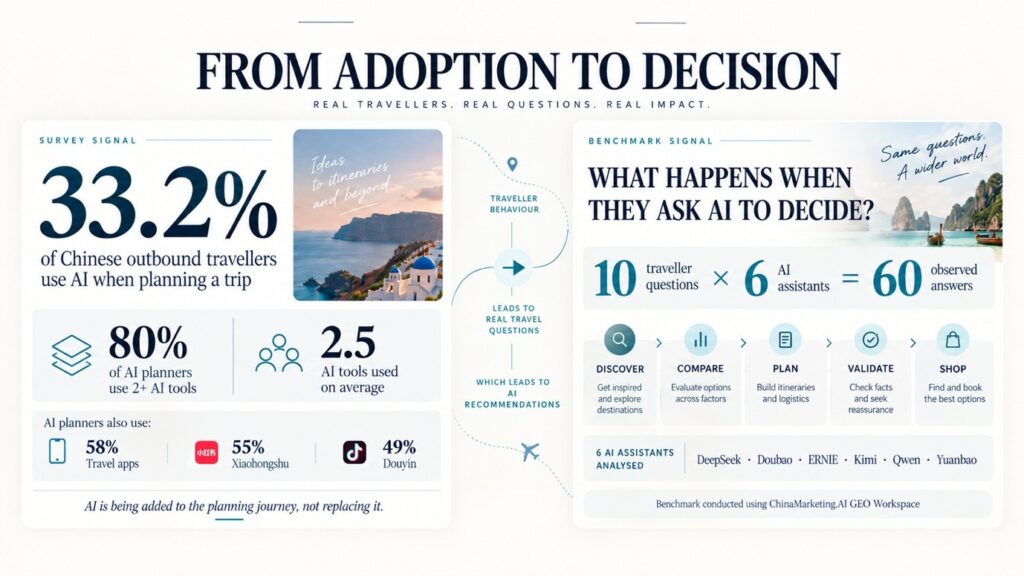
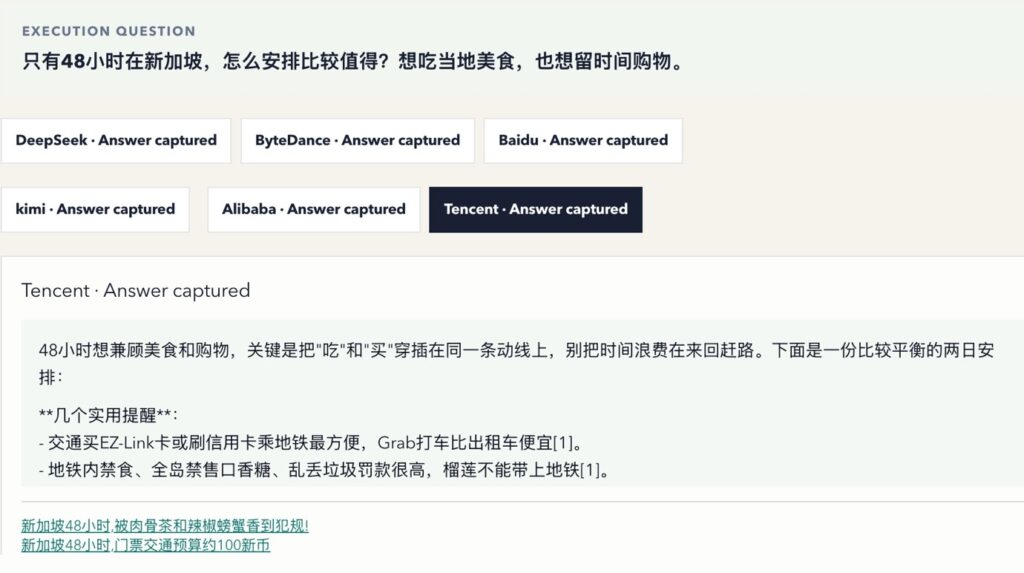
Using our ChinaMarketing.AI GEO Workspace, we ran ten ordinary travel questions across top six Chinese AI apps: DeepSeek, ByteDance’s Doubao, Baidu’s ERNIE, Moonshot AI’s Kimi, Alibaba’s Qwen and Tencent’s Yuanbao. The questions were deliberately practical: Where should I go in Asia for five days? Is Seoul or Tokyo better for a first visit? How should I spend 48 hours in Singapore? Is Thailand safe now? What should I buy at Changi Airport rather than in the city?
The clearest finding was this: AI did not just provide information. It made choices.
Give it a budget and it narrows the destination list. Give it two cities and several systems recommend one. Give it 48 hours in Singapore and it builds a route around food, sightseeing and shopping. Ask what to buy in Korea and the answer quickly moves into categories, retailers and gifts.
For years, the job was simple enough: make sure the traveller found you.
AI adds a second question: once you have been found, do you make the itinerary?
A traveller may no longer read twenty Xiaohongshu posts, six hotel pages and four shopping guides and then piece everything together alone. AI can turn that research into a short itinerary, a few places to visit and a handful of things worth buying.
In our Seoul questions, certain districts kept appearing in the suggested itineraries. In Singapore, Marina Bay, Orchard Road, Chinatown and Changi came up repeatedly when the systems had to decide what was worth fitting into a short visit. In the Korea shopping question, Olive Young and beauty categories quickly became part of the recommended purchase path.
That does not mean those places or brands permanently “rank” in AI. We captured a set of observed answers, not a universal league table.
But it does point to a new problem for destinations and retailers: being visible does not mean being chosen.
The AI assistants were often more consistent about the recommendation than the facts behind it. Questions involving Japanese tax-free shopping, exchange rates, Thai entry rules and safety produced confident answers, but some of the detail varied.
The problem is that AI can sound certain even when some of the facts underneath are shaky.
For destinations, airports, retailers and hotels, the response is not to produce more generic content. It is to make useful, current information easier to find and understand. Prices, tax rules, opening hours, payment options, transport instructions and product availability all matter because AI may be summarising those details before the traveller sees them.

Across Xiaohongshu, Douyin and WeChat, we found examples of people describing a hybrid planning process: use AI to organise the trip, then use Xiaohongshu, Dianping or Ctrip to check the latest details, reviews and lived experience.
Social still creates desire. Travel platforms still help people book. Official sources still matter when travellers need certainty.
But AI is starting to sit in the middle and turn those signals into a plan.
The feed still influences what enters the itinerary. AI is increasingly helping decide what makes the final cut.
For travel businesses, that may become a much tougher test than simply being found.
Methodology
China Trading Desk conducted this editorial benchmark using the ChinaMarketing.AI GEO Workspace. Ten natural Simplified-Chinese traveller questions were tested across DeepSeek, Doubao, ERNIE, Kimi, Qwen and Yuanbao, producing 60 observed AI responses across discovery, comparison, planning, validation and shopping decisions. We also ran two related social-search queries across Xiaohongshu, Douyin, WeChat Channels and WeChat Official Accounts. The exercise is directional research rather than a population study, permanent model ranking or proof of source causality. Survey context comes from CTD’s Q3 2026 China Outbound Travel Sentiment Survey of 15,135 completed responses, fielded 1–2 September 2026.












To subscribe free, please enter your email address: