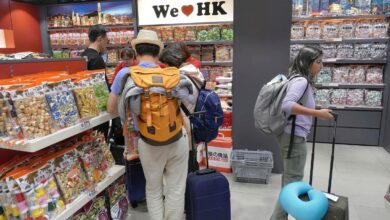
2025: The Year “The Chinese Shopper” Died. Why Travel Retail must stop asking: “Is China back?” and start asking: “Which China Are We Building For?” By: Subramania Bhatt


For most of 2025, global travel retail kept circling around the same question: “Is China back to 2019 levels?”
It sounds like strategy. It’s really nostalgia. Yes, volumes recovered, seats were filled. terminals got noisy again. On many dashboards, the story looked reassuring: traffic lines mostly pointing up, Chinese share of passenger mix climbing, familiar nationalities returning to familiar hubs.
But if 2019 is still your reference point, you’ve already missed the plot.
The real story of 2025 wasn’t just traffic. It was fragmentation. Not of routes, but of who is actually walking through your terminal – and how differently they think, shop and decide.
The simple fact is, there isn’t one “Chinese shopper” anymore – if there really ever was. There are multiple Chinas moving through your airport every day, with different incomes, devices, hesitations and expectations. Unless you choose which China you are building for, you will end up serving none of them particularly well.
That’s why, according to Subramania Bhatt, Founder and CEO China Trading Desk, he suspects that we will look back on 2025 less as the year China “came back”, and more as the year the old, singular idea of the Chinese shopper finally died.
It’s a very insightful read. It may make uncomfortable reading for some, but it is absolutely on point, breaking down the different types of Chinese shopper, their values and expectations. This feature asks the questions that need answers and sets out to provide meaningful and actionable guidelines that will make Travel Retail a more inviting place for Chinese shoppers to spend their money.
The wrong question
“Is China back?” puts all the emphasis on macro indicators: outbound numbers, flight capacity, visa policies, exchange rates. They matter. But none of them tell you whether your environment actually works for the people standing in front of your shelves.
Travel retail no longer has a traffic problem with China. It has a fluency problem.
We have become very good at measuring how many Chinese travellers are back. We are still remarkably poor at measuring how many of them feel fluent enough in our environments to actually say “yes”.
That gap is where 2025 quietly rewrote the rules.
The many Chinas in your terminal
Across three pieces I wrote for TRUnblocked last year – on the She Economy, on Europe’s readiness, and on the rise of first-time Chinese travellers – the same pattern kept showing up: there is no single “Chinese shopper”. There is only the China you choose to design for.
At a minimum, four Chinas are already clearly visible.
There is the She Economy: the woman who now runs a disproportionate share of your P&L. She is young or young-at-heart, urban, digitally native and socially networked. Her discovery happens long before she reaches your airport. Her “top of funnel” is Xiaohongshu, Douyin and WeChat, not your gondola endcaps. She doesn’t just buy lipstick and skincare; she curates identity. She is interested in stories, limited drops and rituals she can film and share. She will still look at price, but she is not defined by the size of the discount so much as by whether the product and the experience feel like her.
In our Q3 2025 CTD survey, almost 40% of outbound Chinese were first-time travellers – most of them younger, more female and more Tier-3 than the pre-pandemic norm.
There is the cautious first-time traveller, who may be new to international travel or to certain regions. On her phone, she is highly fluent: she has researched products, saved screenshots, followed creators, maybe even price-checked in advance. In your terminal, she is structurally unsure. Is this the right store? Is this price fair, or am I being taken advantage of? What happens if she can’t explain what she wants in English? Is tax-free here really better than buying at home? Faced with that uncertainty, she does what cautious people do in unfamiliar systems: she hesitates. She walks in circles, messages friends, re-checks apps and often walks out with nothing, even when she has the budget to spend.

There is the Silver Economy: older Chinese travellers finally taking the trips they postponed for family and work. They may have significant savings but often feel overlooked by environments clearly designed for younger, hyper-digital shoppers. They move more slowly, ask more questions, and put more weight on service, politeness and perceived respect than on marginal price differences. They are frequently buying for families, not just for themselves. They don’t need AR mirrors and flashy screens; they need chairs, patient staff, clear explanations and straightforward gifting options.
Cutting across these groups you see two powerful mindsets. One is the Value Economy: promotion-savvy, brand-aware but not brand-blind, happy to pay for quality but allergic to feeling “stupid” for having paid more than friends. The other is the Emotional Economy: travellers who treat shopping as part of the trip’s meaning – a way to mark the moment, not just arbitrage price.
Put all of this together and a hard truth emerges. If your answer to “Which China are we building for?” is “Chinese outbound travellers aged 18–65”, you have not answered the question. If your answer is “all of them”, your real answer is “none of them”.
A serious 2026 strategy needs you to name one primary China you are designing around, and one secondary China you deliberately support. Everything from your layout and assortment to staffing and digital handoffs should then be tested against those two, not against a generic, fictional “Chinese shopper”.
From traffic to fluency
Most travel retail environments are still optimised for a world where the store is where discovery begins and discount is the main lever. In reality, if she isn’t sure what she’s buying, the exact percentage discount quickly becomes irrelevant.
They assume homogenous groups and bus drops; what they increasingly get are fragmented, self-directed journeys: couples, solo travellers, multi-destination itineraries, people arriving with wildly different degrees of experience and confidence.
We are operating in what I think of as a Confidence Economy – one where spending is driven less by surplus income and more by surplus reassurance.
The biggest hidden competitor is no longer another airport or another brand. It is indecision.
The sale you lose is often not to someone else, but to a traveller who quietly decides to “think about it and buy later” and then never does.
If your environment is not legible, kind and confident for the She Economy, for first-timers, for Silver travellers and for value-conscious shoppers, your Chinese performance will lag your Chinese traffic, no matter how many flights you add.
From tax-free products to decision infrastructure

For years, the core proposition to Chinese travellers was simple: global brands at tax-free prices. The rest, it was assumed, would take care of itself.
That era is over. You can keep investing in more of the same footprint, or you can invest in infrastructure that helps specific travellers decide. 2025 quietly proved you can’t do both equally well.
The real battleground is what sits around the product: the decision infrastructure that helps a traveller move from maybe to yes.
Parts of that infrastructure are upstream. What appears on Xiaohongshu, Douyin, Ctrip or Fliggy before the trip shapes what feels normal and safe in your terminal. If your brands, bundles and prices are invisible or inconsistent there, you are already swimming against the current when she walks into your store. The conversation has started without you.
Other parts are in the store itself: bilingual signage, category logic that makes sense, visible price comparisons, QR codes that explain rather than confuse, layouts that make it obvious where to go and what is special. The goal is not to impress her with complexity; it is to let her understand your environment within 30 seconds of walking in.
And then there is the human layer. Here the gap is often at its widest. A single, well-trained Mandarin-speaking BA, empowered to solve problems and explain with patience, can unlock more revenue from cautious first-timers than another ten metres of gondola. You can see the opposite every day as well: a traveller finally gathers the courage to ask a question, meets a blank stare or hurried response, and quietly abandons the purchase.
When I argued that Europe “isn’t ready” for the evolved Chinese traveller, this is what I meant. Structurally, many European hubs still assume that traffic plus tax-free equals performance. They are over-invested in physical footprint and under-invested in fluency.
What 2025 really told us about China
Taken together, the She Economy, the rise of cautious first-timers and the test that Europe has become all point to the same conclusion.
The centre of gravity has shifted from the idea of a monolithic “Chinese shopper” to a portfolio of very different Chinas. The mass affluent narrative has given way to a Confidence Economy, where reassurance, not just income, is the gating factor. And Europe, once treated almost as a default playground, has become the most visible exam hall for whether your fluency is real or performative.
In that sense, my three TRUnblocked pieces last year were not three separate stories. They were three angles on one truth: Chinese performance in travel retail will no longer be driven primarily by volume. It will be driven by how fluently your environment fits the specific Chinas you choose to serve.
Which brings us to the uncomfortable part: what you do with that this year..
Three hard questions for 2026
Planning season is when comforting narratives are most dangerous. So it may be worth asking yourself three questions before you proudly key “China recovery” into your budget assumptions.
The first is the one we’ve already touched on: who is your primary China?
If your segmentation slide still effectively says “Chinese outbound travellers 18–65, mid to high income”, you are working with a cartoon. Name a real persona: She, first-time, Silver, value-led, emotional, or a clearly defined combination. Then walk your terminal as that person. Would she recognise herself in your assortment, communications and services? If not, your performance gap is not a mystery; it is a design choice.

The second is about fluency. How fluent is your environment, really?
Not in theory, but in practice. Can your primary persona find her way from gate to store to till without confusion? Does she understand your key offers and your price advantage without having to decode small print? Can she pay the way she is used to paying, with clear currency handling? Can she access help from someone who can meet her in Mandarin, or at least with culturally competent English? Does what she sees on your shelves resemble what she has been primed to expect on Chinese platforms? An honest walk-through with those questions in mind will give you a much more useful readiness index than any 2019 comparison.
The third is financial. Are you over-investing in discounts and under-investing in confidence?
Look at your budgets. How much are you spending on margin-eroding promotions aimed vaguely at “Chinese shoppers”? How much on staff training, Chinese-language capacity, upstream digital integration and information design? Reallocating even a fraction of a discount budget into decision infrastructure is uncomfortable, because the benefits don’t show up as neatly as a “-20%” tag. But in the Confidence Economy, that is where the real competitive advantage now lies.
The year the old story died
Over the course of 2025, watching Chinese travellers move through airports and talking to brands, operators and landlords who are trying to catch up with them, one conclusion has been hard to escape:
There is no single “Chinese shopper” anymore. There is only the China you choose – or fail – to design for.
2025 will not be remembered primarily for the fact that China “came back”. It will be remembered as the year the old, comforting idea of the Chinese shopper finally died.
In its place we now have a messier, more interesting reality: and it’s She Economy travellers, cautious first-timers, Silver couples, value hunters, emotional spenders and hybrids of all of these, changing with the macro mood and with platform culture.
The winners in the next phase of travel retail will not be the ones shouting loudest about Chinese recovery on conference stages. They will be the ones who quietly answer a harder question in their own buildings:
Which China are we actually building for – and have we created an environment where she can say yes? Because she is already in your terminal. She is comparing. She is hesitating. She is scanning, scrolling and asking her friends.
If you do not design for her now, someone else will.


To subscribe free, please enter your email address: