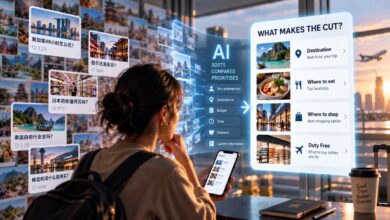


Why Shelftrak Is Such An Important Tool For The Travel Retail Industry. MD Garry Stasiulevicuis Interviewed


Since its launch, Shelftrak has become an invaluable tool for all in travel retail who have used it. I recently caught up with Garry Stasiulevicuis and had a no-holds barred interview to get to a fuller and deeper understanding of just how important Shelftrak is in terms of what it delivers to the business community. Simply put, it leads the AI-driven future of retail execution.
Peter Marshall (PM): Garry, welcome back to TRunblocked.com. It’s been quite a year for you so far and we are only in June. Please take us all through the key changes with Shelftrak.
Garry Stasiulevicuis (GS): Thank you Peter, it has indeed been a transformative year for Shelftrak. The most significant development is our transition into a standalone entity, enabling us to operate with increased strategic clarity and pace.
We’ve refined our mission to become a technology-led insight business, delivering AI-powered intelligence that transforms how brands and retailers approach execution in travel retail. By providing consistent, global shelf-level data, we enable stakeholders across the channel to make smarter, faster decisions that directly improve shopper engagement and experience. Our expanded service and category coverage ensures we’re not just capturing data – we’re turning it into actionable insight that drives measurable impact for both brands and retailers worldwide.
Two major changes stand out:
AI Advancement: We’ve heavily invested in our proprietary image recognition technology, achieving high levels of accuracy in SKU-level execution tracking. This has vastly improved our ability to deliver the speed of insight to clients, allowing them to take fast and corrective actions based on our data.
Market Expansion: We have now started to fully cover the Tobacco category across our estate with some key clients from this sector joining our rosta of users. Additionally we have piloted the service with Beauty and we’re working closely with leading Beauty brands to progress this to a fully fledged service.
PM: Well, it’s now worth briefly reminding everyone what unique features Shelftrak delivers and what your global reach is.
GS: Shelftrak combines cutting-edge AI with retail execution tracking to offer an entirely unique data set that provides metrics for all aspects of what’s happening on shelf across the industry.
In summary, our AI-Powered Image Recognition tool allows us to analyse thousands of retail fixture photos to track SKU-level positioning, share of space, price, promotions, and display compliance.
We have a clearly defined dual-service model:
The Global Tracking Service, covering 50 airports and 70+stores, offers triannual strategic insights into retail execution across travel retail globally.
The Shelftrak App empowers in-store teams or our fieldwork team to gather real-time execution data for immediate reporting that leads to corrective action in store.

PM: So how would you say that Shelftrak differentiates itself from traditional retail measurement tools like Nielsen?
GS: Shelftrak offers a fundamentally different and more actionable view of retail performance compared to traditional tools like Nielsen. While Nielsen provides POS sales data—telling you how much was sold – Shelftrak shows you why it sold (or didn’t) by capturing what’s actually happening on the shelf.
We deliver precise visibility into product placement, pricing, promotion, facings, and compliance at the SKU level, uncovering missed opportunities, out-of-stock drivers, and competitor encroachments that sales data alone can’t reveal. This makes our data uniquely suited for real course correction, stronger retailer negotiations, and stronger, data-driven decision-making about the quality of the retail interface.

PM: I know you have strong feelings about clutter on shelves and your Sku Density Ratio (SDR) metric does address overcrowded shelves. But how does your fast-evolving AI handle obscured labels or densely-packed products in high traffic areas in airports? What validation do you have that proves SDR can effectively improve shopper experience compared to merely quantifying clutter?
GS: Cluttered and overs-stocked shelves are not just an aesthetic issue – they actively hinder product discoverability, disappoint shoppers and ultimately reduce conversion. We use the Sku Density Ratio (SDR) as a metric that moves beyond simply identifying crowded shelves. SDR quantifies how the physical density of SKUs affects visibility, shop-ability, and ultimately the shopper experience.
Our AI-powered image recognition models are at the heart of this. Designed specifically for complex, high-traffic environments we see in airports, they go beyond surface-level detection. They:
But perhaps most importantly, using SDR isn’t theoretical – it’s been tested and validated in-market. In multiple scenarios with global brand clients. Where we’ve highlighted poorly executed stores and made corrections, we’ve seen;
These results confirm Shelftrak and our measures don’t just point out clutter, we identify how clutter impacts consumer behaviour, giving brands and retailers the evidence and tools they need to act.
In short, Shelftrak data turns the shelf into a measurable, optimisable asset, validated by real-world shopper impact.

PM: Travel retail, by definition, spans different regions and countries. Does your AI model account for different regional variations in products, language barriers and cultural shopping behaviours without frequent manual recalibration?
GS: Our AI models are specifically trained for the complexities of travel retail, where regional product variations, multilingual packaging, and diverse promotional formats can be seen in store. Our AI model is capable of recognising and capturing multilingual labels, culturally distinct packaging, and localised in-store messaging with high accuracy.
What makes our system resilient is the depth and diversity of our training data. Over the past two years, we’ve compiled a vast, globally-sourced image bank from stores in Europe, Americas, the Middle East and Asia. This allows our AI to handle everything from local niche SKUs to global brand variants without the need for frequent manual recalibration.
Crucially, our models are also continuously learning. With each new data collection cycle, their knowledge is retrained and augmented using fresh images, new products, and updated display contexts, ensuring ongoing adaptability and precision. Whether it’s a limited-edition product in Singapore or a seasonal promotion in Paris, our AI adapts to delivering consistent, high-quality insights across geographies and cultures.
PM: Developing this, I understand you claim your service to be 100% accurate. But there is human oversight, so there’s always the possibility of human error, isn’t there? How do you balance the trade-off between speed and accuracy?
GS: Great point. We never claim infallibility – but our AI consistently performs with better-than-human accuracy. Like any big data company, we have built in tolerances to account for unforeseen issues that impact photo quality and readability.
Our system uses AI for rapid classification and measurement, with human teams stepping in for verification, edge cases and complex situations. We see human verification very much as a key layer of quality control to ensure consistency and integrity before data is published.
We’re constantly fine tuning our process to ensure that speed does not compromise reliability. We’re confident that our hybrid model is more accurate than either just human or just AI alone.

PM: You claim to provide rapid insights to clients. How do brands use data and why is speed of reporting important?
GS: Speed is absolutely critical, and it’s one of the key reasons clients rely on our Shelftrak App. This service is specifically designed for tactical, fast-turnaround insight, enabling brands to monitor their in-store presence at speed.
Brands deploy the Shelftrak App to brand ambassadors, store teams, or Shelftrak’s own fieldwork teams to track things like display compliance, pricing, and promotional execution on a monthly or even bi-weekly basis. These checks are typically focused on a specific set of priority fixtures or promotional displays in key stores or locations.
Brands invest heavily in planograms, branded fixtures, and in-store promotions – without frequent feedback, they’re often blind to how consistently these executions are implemented. The Shelftrak App allows them to close that gap.
Each display is given a compliance score, which is then aggregated up to store, airport, regional, and even global levels, providing a clear, data-driven picture of execution quality across markets.
The real benefit of this speed is actionability. Instead of waiting weeks for results from a traditional audit, brands can take corrective action at pace. Whether that’s contacting a retail partner, sending a field rep back in, or adjusting future planograms. We’ve seen time and again that brands who track and improve display quality consistently see an uplift in conversion and sales.
PM: Now, most of your clients are brands, and your client list has been expanding rapidly. The key question I have to ask is this: has the data you’ve provided actually made a difference in discussions these clients are now having with their retail partners?
GS: Absolutely—and the difference has been both strategic and we believe it can be transformational.
Brands are now using Shelftrak data not just to monitor execution but to actively shape conversations with their retail partners. The insights we deliver are giving brands hard evidence to defend, reclaim, or gain shelf space. This has become especially important in scenarios where certain segments are over-ranged or over-spaced, and brands want to push for a rebalance in execution to reflect shopper needs more accurately.
In practice, this means brands are saying:
This is category leadership through data, and it’s resonating with retailers.
What’s even more powerful is how comparative benchmarking across different retailers has added a new layer to these discussions. Shelftrak provides visibility that most retailers themselves don’t have access to – especially when it comes to:
We see that retailers are now engaging with this insight not defensively, but collaboratively. From what we see, they’re increasingly welcoming the data as a neutral, third-party view of what’s really happening in-store. It’s helping them make smarter, data-backed decisions about how to optimise category performance and improve shopper satisfaction.
In short, we believe that Shelftrak can become a shared language between brands and retailers, enabling more productive, evidence-based conversations.

PM: You’ve made your mark with many brands in both liquor and confectionery. And now, as you mentioned earlier, you have moved into Beauty and tobacco. Do these two categories present different types of challenges to you?
GS: Yes, both Beauty and Tobacco introduce unique and complex challenges, each requiring tailored approaches and technological adaptations.
Tobacco, for instance, is shaped by heavy regulation and strict visual restrictions, especially in regions where plain packaging laws are enforced. In these markets, brand logos and colour cues are removed, making traditional visual recognition almost impossible. Instead, we rely on advanced Optical Character Recognition (OCR) technology, which becomes essential.
Our OCR engine uses AI to:
Because of the limitations in visual branding, high-quality data capture is critical to success in this category. Our AI’s OCR capabilities and trained verification team allow us to work within these constraints while maintaining data integrity.
On the other hand, Beauty presents a different set of challenges, particularly due to the sheer volume and complexity of SKUs. Take lipstick, for example, one brand can have dozens of shades, each with nuanced differences in colour, finish, and packaging, making visual recognition highly granular and difficult. Additionally, beauty products are often displayed in drawer-based units, specialised showcases or testers and also mixed fixtures, which complicate both visibility and accessibility
Given this, we take a tiered measurement approach in Beauty:
We are actively collaborating with leading beauty brands to co-develop reporting models that strike the right balance between detail and practicality—offering insightful, usable data without overcomplicating field execution.
What ties both categories together is the adaptability of our AI. Whether navigating text-only detection in Tobacco or solving for complexity and display irregularity in Beauty, our system flexes to meet the operational demands of each sector.
PM: So, last question, Garry. What are the three things that you think can motivate either brand or retailer to use Shelftrak?
GS: Absolutely. The three core areas :
Shelftrak provides evidence-based insight for users to see if a brand or segment is getting a fair share of space and how well that space is being used. It measures the accuracy and quality of display execution – including SKU presence, correct facings, shelf positioning, and pricing – so as an example, brands can ensure that what was agreed in principle is actually delivered in-store. This transforms visibility into accountability and action, helping fix execution gaps quickly and maintain high standards globally.
Shelftrak is the only data provider in travel retail offering true benchmarking at a global, regional, and intra-airport level. This means brands and retailers have one source of truth on which to base discussions. .
By providing consistent, SKU-level metrics, Shelftrak uncovers where space is underutilised, where execution quality is falling short, and where competitors are gaining ground. This enables brands to defend or win back shelf space with hard evidence, and helps retailers identify high-and low-performing zones to drive more effective merchandising strategies that improve conversion.
It’s not just about measuring what’s there – it’s about revealing where and how to improve, backed by data that has never been available before in this market.
Shelftrak is a unique, independent data source that enables genuine collaboration between brands and retailers—rooted in a shared goal: improving the shopper experience.
Unlike internal reports, fragmented or single-locations sales data, Shelftrak delivers trusted, shelf-level insights that neither party typically has on their own. It creates a common language built on shelf economics, that shifts conversations from subjective opinion to objective evidence.
By focusing on what really matters to the end consumer – clear navigation, accessible products, and consistent execution – Shelftrak becomes the catalyst for smarter, shopper-first joint planning. In a fragmented, data-light market like travel retail, this kind of transparency and alignment isn’t just beneficial – it’s essential.
In short, Shelftrak helps brands and retailers move from guesswork to insight, and from reaction to action.












To subscribe free, please enter your email address: