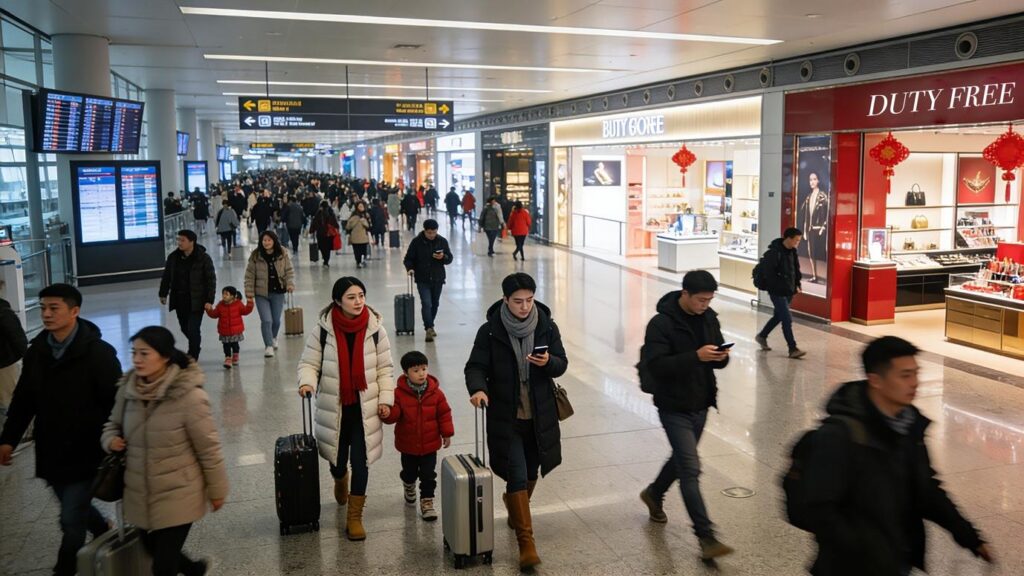
The Chinese New Year Illusion: Crowded Terminals May Make Recovery Visible. They Do Not Make Conversion Automatic.


Chinese New Year 2026 delivered the headline the industry wanted: Chinese travel is back, traffic is up, and confidence is returning. But an increase in Chinese travellers actually flatters to deceive. Recovery in movement is not the same as recovery in monetization. The real post-CNY story is not whether Chinese travellers moved – it’s whether brands, retailers and destinations were still relevant enough to capture the wallets moving through them.
This is a uniquely insightful and sharply-written feature from Subramania Bhatt, CEO China Trading Desk. There are some hard truths here which travel retailers and the wider industry should take note of.
China recorded 596 million domestic trips and RMB 803.5 billion in domestic tourism spending over the nine-day Spring Festival holiday. Cross-border traffic reached 17.8 million trips, with average daily crossings up 10.1% year on year.
The easiest conclusion is already writing itself: China moved, therefore China spent. Traffic is back, therefore retail is back. The traveller returned, therefore the tills should follow.
But that equation is far too neat. Mobility is not monetization, and a rise in passenger flow does not automatically translate into commercial relevance for every brand, retailer or destination that happens to sit somewhere along the journey.
And the size of the outbound wallet makes that distinction even more brutal. In our 2026 projection, Chinese outbound will reach 175 million trips and US$280 billion in overseas travel spend. But only part of that wallet is actually available to retail. Roughly US$85B goes to accommodation, US$52B to food and beverage, US$40B to local transport, and US$24B to entertainment and services. Shopping remains significant, at roughly US$79B in total, but even that is split between around US$23B in travel retail and US$56B in in-market shopping.
In other words, more travellers does not mean more spend is there and waiting for you. It means more categories are competing for it.
The opportunity is real. The entitlement is the illusion.
For years, the industry got used to a version of Chinese outbound travel that was easy to romanticize and even easier to exploit: price-gap shopping, logo chasing, bulk buying, and itineraries built around retail extraction. If the flights were full and the group tours arrived, the commercial logic took care of itself.
That model is breaking down.
Chinese travellers are still moving in huge numbers, but more are travelling independently, spending on experiences, planning purchases before departure, and looking for exclusivity, local distinctiveness and ease rather than treating every overseas store as a cheaper extension of home.
So no, more trips do not mean more money is automatically available to you. They mean you have more chances to earn it.
A Big Holiday Can Make Weak Businesses Look Healthy
This is the part the industry rarely says out loud.
A strong CNY flatters weak operators. A busy terminal can make an irrelevant store feel viable. A high-volume holiday can make generic activations look temporarily effective. A rebound in Chinese travel can give management teams just enough cover to confuse “good market conditions” with “good commercial execution.”
They are not the same thing.
The problem with headline numbers is not that they are wrong. It is that they are incomplete. Trips tell you people moved. Borders tell you people crossed. Bookings tell you intent existed somewhere in the system. None of that tells you whether your store, your category mix, your pricing, your experience or your service actually deserved the wallet in front of it.
Yet travel retail still loves passenger growth because it is the easiest metric to celebrate and the hardest one to challenge. It sounds strategic while demanding very little honesty.
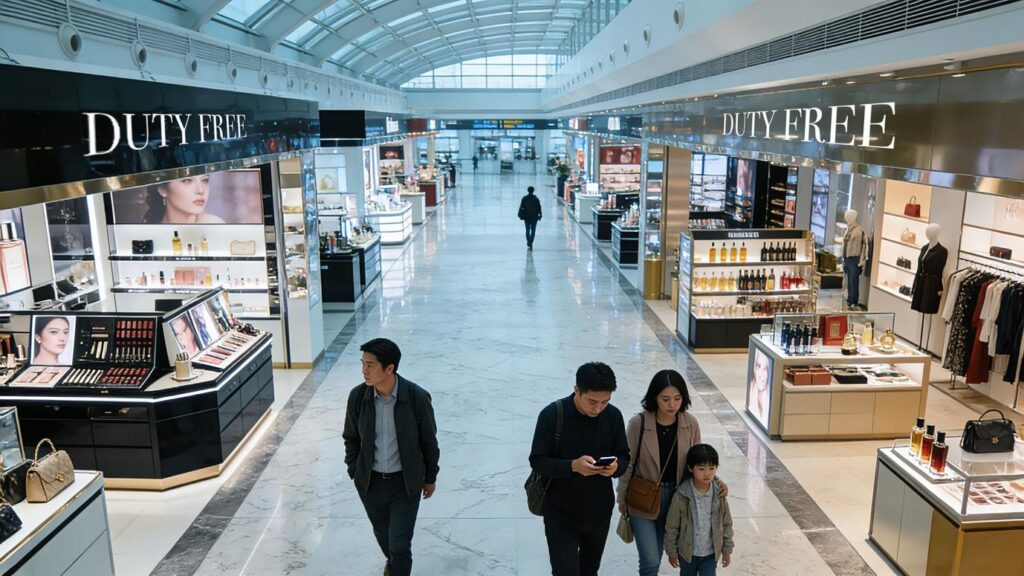
The Shelf Is No Longer Where the Story Starts
The old travel retail fantasy still lingers: the Chinese traveller arrives, browses, discovers, gets tempted, and buys.
That fantasy is aging badly.
Today, much of the decision-making happens before departure, inside Chinese digital ecosystems, and long before the passenger gets anywhere near a shelf. The trip is researched early. The destinations are filtered early. The shortlist is built early. In many cases, the purchase list is built early too.
That changes the commercial battlefield.
If the traveller has already done the mental work before departure, then the store is no longer the beginning of persuasion. It is the final test of relevance. And too many travel retail environments still behave as though attention begins at the shelf.
It doesn’t. Not anymore.
More importantly, the purchase logic itself has changed. Chinese travellers are no longer primarily shopping overseas to exploit price gaps. In many categories, that arbitrage is weaker, less obvious, or simply no longer compelling enough to drive spontaneous buying on its own. What drives visits now is much more deliberate: overseas-only products, destination-specific exclusives, limited editions, culturally distinctive local brands, and items already validated through social content before the trip begins.
The store is not being asked to manufacture desire from scratch. It is being asked to fulfill desire cleanly.
That is a very different job. And a lot of operators are not built for this.
The feed matters. Search matters. Social proof matters. Pre-trip reassurance matters. Category confidence matters. Payment clarity matters. Mission fit matters.
A Chinese New Year visual slapped onto a legacy retail proposition is not localization — it is seasonal decoration.

CNY Is No Longer One Travel Moment
The industry still talks about “the CNY traveller” as if this were one behavioural category.
It’s not.
CNY now compresses multiple travel missions into the same seasonal window: reunion travel, short-haul convenience breaks, longer-haul aspiration journeys, slower, more experience-led holidays, and more. Those missions may overlap in timing, but they don’t overlap neatly in commercial expectations.
A family traveller may care most about convenience, speed, clarity and the reassurance that the experience will not become another source of stress. A high-intent luxury traveller may want privacy, exclusivity and a reason to visit that goes beyond global logo familiarity. A younger traveller may be less interested in heritage cues than in local discovery, social validation and something worth sharing. A senior traveller may simply want comfort, legibility and the absence of friction.
Treat them all as one CNY shopper and you do not create a broad proposition. Yet many operators still build one blunt festive retail story and hope traffic does the rest. Hope, volume and festive signage are not a strategy.

The Real Revenue Leak Is Friction
Brands sometimes talk as though Chinese travellers have simply become harder to win. In many cases, the problem is less flattering: the store has become easier to ignore.
The friction points are rarely glamorous, but they are decisive — uncertainty around Alipay or WeChat Pay at point of sale, cumbersome tax refund processes, weak after-sales reassurance, and staff engagement that still treats Chinese travellers as a nationality rather than as a set of distinct purchase missions. In a market where travellers are increasingly pre-planned, time-sensitive and selective, friction is not a service issue.
It is a revenue issue.
And the more intentional the traveller becomes, the less tolerant they are of retail environments that ask them to work too hard. If they already know what they want, then every extra layer of uncertainty becomes a reason not to buy. If they are travelling with family, every operational inconvenience gets amplified. If they are shopping for exclusivity, generic presentation kills urgency.
This is the trap many operators still fail to see: they think conversion is being lost because Chinese travellers have become harder to win. In many cases, conversion is being lost because the store has become easier to ignore.
The Industry Is Still Reading the Wrong Scoreboard
Here is the real post-CNY problem: travel retail is still measuring the wrong victory. The industry celebrates arrivals when it should be auditing capture.
How much spend was decided before the passenger even left home? How much conversion was lost to friction rather than price? How much basket value disappeared because the assortment was too broad, too stale, or too obviously built for a traveller who no longer exists? How much confidence was lost because the environment asked for browsing when the passenger arrived with a mission? How much value leaked because the store confused visibility with relevance?
Those are the questions that matter – not whether footfall looked encouraging during the holiday peak.
The real strategic question is not just whether Chinese outbound grew, but which layer of the wallet you were ever structurally positioned to win. Hotels fight for nights. Destinations fight for itinerary share. Attractions fight for time. Retail fights for conversion. Confusing those layers is how weak operators turn macro growth into self-congratulation.
More Chances, Not More Entitlement
Chinese demand is not disappearing. But it is becoming more selective, more filtered, and less forgiving.
The opportunity remains significant, but what it rewards has changed. It rewards brands and retailers that show up before the trip begins. It rewards propositions built around specific travel missions, not generic nationality assumptions. It rewards operational ease, cultural confidence, digital compatibility and a reason to visit that goes beyond ‘we have a store in a place Chinese tourists pass through’.
Our modelling makes another point the industry still resists: volume winners and value winners are not always the same markets. Near-haul corridors can dominate on arrivals and frequency, while long-haul corridors can outperform on spend per visitor because the trip is longer and the daily basket is richer. The mistake is assuming that passenger scale and commercial value naturally map onto each other. They do not.
More trips do not mean you deserve more spend. They mean you have more chances to earn it.
That is a harder message because it removes the comfort blanket: CNY traffic cannot substitute for commercial imagination, and passenger recovery cannot keep masking retail mediocrity.
And honestly, that is healthy.
Because the era of indiscriminate Chinese spend was always a dangerous thing for the industry to depend on. It rewarded laziness, tolerated sameness, and made too many people think presence was the same as relevance.
It isn’t the same thing.
So Here Is the Real Post-CNY Question
Not: Is China back?
Not: Did traffic recover?
Not: Was CNY strong?
Those are easy questions for people who like comforting answers. The harder question is this:
If Chinese travellers are moving in record numbers and you are still not winning enough of their wallet, what exactly have you built?
Because CNY 2026 did not fail to reward the industry. It simply stopped rewarding it indiscriminately.
And that’s not bad news.
That is overdue discipline.


To subscribe free, please enter your email address: