


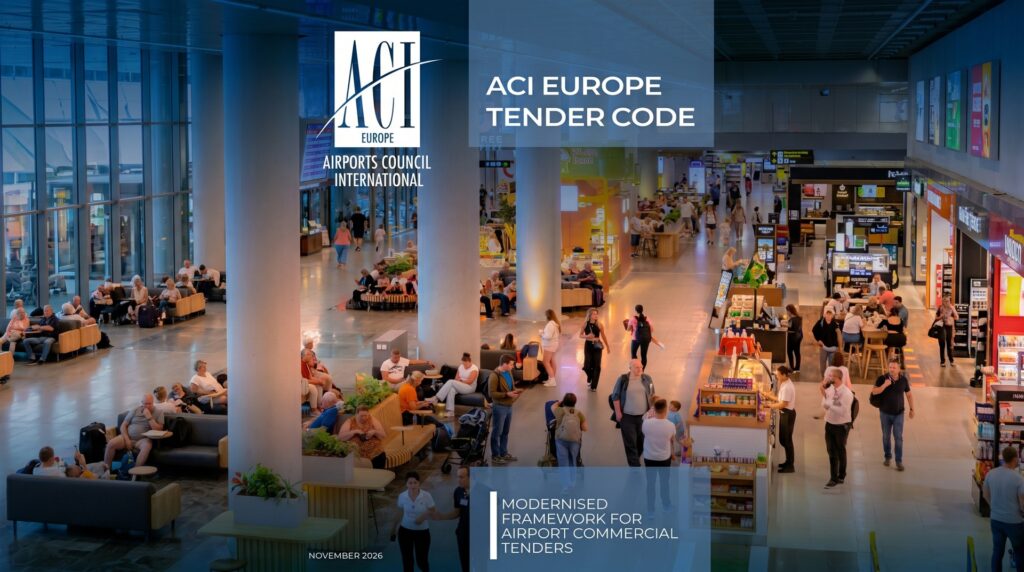
The Industry Just Got Honest: ACI Europe’s Tender Code Finally Grew Up


A quarter of a century on, ACI EUROPE has brought its Tender Code up to date. It deserves real credit – and the rest of us now have a genuine chance to help finish the job.
Some industry documents deserve a round of applause just for arriving. ACI EUROPE’s modernised Tender Code, happens to be one of them.
The first code actually came out in 2001, with the Best Practice Charter following in 2005. Since then, airport commercial revenue has been through a financial crisis, a pandemic, a war that reshaped traffic mix, a digital revolution in the way people shop, and years of pressure on the fixed-guarantee concession model. Through all of it, the rulebook the industry tenders by stayed exactly where it was.
So the fact that it’s moved at all – let alone this far – says a great deal about the people behind it. The working group was pulled together by Martijn Steur of Kinetic Consultancy, within the ACI EUROPE Commercial Forum. Round the table were airports large and small – Brussels, Vienna, Zurich, Fraport, Düsseldorf, Bologna, Riga and AviAlliance. Plus two of the big retail operators, Avolta and Gebr. Heinemann, and ETRC under Julie Lassaigne. It was ETRC that commissioned the University of Stirling’s business-models study, and that gave the whole review something this industry rarely has – proper evidence instead of a pile of anecdotes. The writing is measured, the structure is clean, and the Annexes are things people can genuinely use. This is exactly how it should be done.
Read closely, it’s a far more candid document than we’re used to. So here’s what it really says. And, just as importantly, where the industry can help take it next.
1. The industry has finally admitted that the highest bid is often the most expensive mistake.
Get past the formal language and this is, at heart, a code designed to stop overbidding. It warns that fixed guarantees “may incentivise aggressive bidding strategies that are difficult to sustain.” It recommends dual-envelope evaluation, so the technical case is judged before anyone opens the money. It wants benchmarking and stress tests on turnover forecasts. And, quite remarkably for a voluntary code – it brings in an Economic Credibility Multiplier, which can knock points off a financial offer if the CAPEX, staffing or margin numbers drift too far from reality. The working group even suggests that once overbidding is spotted, it should count against the bidder!
The lesson is a blunt one. Airport tendering’s problem isn’t underbidding any more. It’s the winner’s curse. And now the Code says so – out loud.
2. Data is the new level playing field – and the Code isn’t shy about the incumbent advantage.
The quiet revolution here is data. The Code says straight out that uneven access to commercial data can “favour incumbents” and skew the bidding. Its fix is data-sharing that works both ways. Airports hand over passenger data at least monthly – forecasts, nationality mix, dwell time. Retailers hand over their sales performance – SPP, ATV, penetration, conversion, sales per square metre, shrinkage – as a contractual commitment that carries on through the deal, not as a favour.
That matters, because data transparency stops being something people talk about at tender time and becomes a permanent, two-way obligation in the contract. The Code even tells airports to get performance data out of the incumbent before the tender goes live. Stick to that one line, every time, and you’ll do more for fair competition than any amount of process guidance.
3. Flexibility should be arithmetic, not negotiation.
The Flexibility and Resilience annex is where the Code really gets practical. It sets out MAG bands that move with traffic, with the triggers agreed up front. Traffic down more than 10% for six months? The MAG comes down 5%. Down more than 20%, it comes down 10%. Down more than 40%, it’s suspended. What used to be a fraught renegotiation is now simple sums both sides signed up to at the start. Add reforecasting, hybrid MAGs linked to traffic segments and inflation, pilot zones for new ideas and the right to reallocate space, and the message comes through loud and clear: build flexibility into the contract on day one, rather than fighting over it in year three.
What does that mean in practice? “Set-and-forget” contracts are officially on the way out. In their place come clear rules and real data, with adjustments both sides can check. And, in the annex, a four-step process for when things get difficult, starting with joint review committees and going right up to third-party auditors whose decisions are binding.
4. Choosing a model is a strategic decision, not a habit.
Drawing on the Stirling research, the section on commercial models refuses to pick a favourite. Fixed MAG, variable rent, profit share, joint venture, airport-run retail, management contract – every one is set out with its strengths and its weaknesses. That includes the frank admission that the traditional model is “highly vulnerable to sudden shocks” and can produce “unrealistic tender bids.” Annex 6 then matches each model to the kinds of airport it suits best. For smaller airports in particular, that’s something they’ve never been given before: permission to break with how it’s always been done and pick a structure that fits the traffic they really have.
5. The tender is won or lost before it’s published.
The line from the Code you’ll hear quoted most is “the conversation about the conversation.” Put simply, get everyone aligned internally – and talk to the market, where it makes sense – on goals, assumptions, who carries which risk, and how bids will be judged, all before anyone digs in. As the Code itself puts it, the success of a tender is largely determined before it is formally launched. That’s much more than a process tip. It’s a different way of running the whole thing. Less a procurement exercise, more the start of a meaningful partnership.
No first edition gets everything right. None of what follows is a criticism of the working group – it’s simply the obvious next agenda. And for each point, we’ve offered a suggestion on how the industry and ACI EUROPE might tackle it.
1. The brand owners are still outside the room. The 2005 Charter recognised that this business is a three-way partnership between airports, retailers and brands. The 2026 working group has airports, retailers, a consultancy and ETRC – but not a single brand or supplier. Brand investment, exclusives and marketing support appear as items to be scored, not as voices in the discussion.
Our suggestion: bring brands into the working group, or set up a standing brand panel to sit alongside it. In a business where so much of the margin is driven by brands, the conversation can only get better.
2. Digital commerce gets a box to tick, not a framework. Pre-order, collection, CRM and retail media are all squeezed into a single line of the technical evaluation. There’s nothing on who owns the digital customer relationship, where the e-commerce boundaries of a concession should sit, or how loyalty and retail-media income should be handled in the numbers.
Our suggestion: give edition two its own digital annex – spelling out the concession’s digital boundaries, who owns the data and how omnichannel performance is measured. This is a document that took 25 years to catch up with the last disruption, so this is probably the gap to close first.
3. A voluntary code runs on trust – so give it a progress report. There’s no list of who has signed up, no tracking of who’s using it, and no date set for reviewing the Code itself. That’s fair enough first time round, but it means everything rests on peer pressure.
Our suggestion: a short annual check on take-up – which airports have used it, and what worked – plus a set timetable for revisions. It would cost very little, and it would turn good intentions into hard evidence.
4. The passenger is treated as data, not as a stakeholder. From start to finish, passenger information is something for bidders to work with. There are clear customer experience measures – mystery shopping, satisfaction, conversion – but nowhere is there any independent passenger research, or anyone speaking for the passenger.
Our suggestion: add a passenger-perspective section to the evaluation guidance – independent survey evidence, accessibility standards, the dwell-time experience – so the customer the Code mentions so often finally gets a voice that counts, and can be measured.
5. The MAG formula still rewards the biggest guarantee. Under the recommended scoring, MAG points still go in proportion to the highest bid, toned down by the credibility multiplier. That takes some of the heat out of overbidding, but it doesn’t put the fire out.
A suggestion worth debating: score MAG against the airport’s own benchmarks and forecasts, and how believable each bid is against them. Score this way rather than against whoever bid highest. That would take the auction out of it altogether. The Code has already opened the door with its credibility checks; the next edition could walk through it.
6. SMEs and local operators get a definition, but no way in. SMEs are defined in the terminology annex, and the section on variable rent notes that it makes it easier for newcomers. But there’s nothing practical – how lots are split, simpler prequalification, staggered criteria – to help more of them take part.
Our suggestion: a “local operator pathway” in the annexes: lighter prequalification for SMEs, smaller lots, and mentoring from the big anchor concessionaires. The “Local Hero” scoring category already shows the appetite is there – a pathway would give it somewhere to go.
Going a step further, here’s our own wishlist, which is offered in the spirit of a framework that deserves to keep growing:
1. A benchmarking pool. The credibility multiplier, the stress tests and the sales-per-square-metre checks all depend on benchmarks the industry doesn’t share. An anonymised pool, run by ACI EUROPE, would make the best parts of the Code actually work – and finally deliver on “from anecdotes to evidence.”
2. A chapter on renewals and extensions. The Code deals with how contracts begin, not how they end. When should extensions be out in the open? When is it fair to renew without going back to tender? And how should an incumbent’s right to match be handled? With contracts running seven to ten years, renewals are where much of the industry’s real worry lies.
3. Guidance on default and payment security. What happens when the winning bidder can’t deliver? Default triggers, step-in rights, guarantees and deposits all need covering. A framework that stress-tests bids, but not what happens when a bid fails, is only doing half the job.
4. A light track for smaller airports. The Code assumes there’s a commercial team on hand to answer the strategic questions in Annex 5. Templates, simpler prequalification and a starter checklist would bring what the framework promises to where most of ACI EUROPE’s 600 members actually are.
5. An outcomes review. At the moment, nobody is measuring whether tenders run the Code’s way actually do better – fewer disputes, fewer renegotiations halfway through, healthier spend per passenger. A regular, anonymised review of results would build the evidence for edition two, and give the Code the credibility data it doesn’t yet have.
Measured, as coverage of this industry should be, the modernised Tender Code is the most useful thing ACI EUROPE has given the commercial side of the business in twenty years. It’s honest about where things go wrong, specific where it needs to be, and built on evidence rather than anecdote. Everyone who gave their time to it – the working group members, Kinetic Consultancy, ETRC and the Stirling researchers – has done the industry a real service.
The gaps are the gaps of a first edition, not a flawed one. The next conversation – brands at the table, digital properly defined, benchmarks shared, results measured – is one the industry should start now. And TRunblocked looks forward to following every step of it.
I hope this has been helpful.












To subscribe free, please enter your email address: